A commercial building that leaks air all day is expensive to own. You feel it in uneven temperatures, rising utility bills, moisture problems, and HVAC systems that seem to work harder than they should. That is why spray foam insulation for commercial buildings has become a serious performance upgrade for owners, builders, and facility managers who want long-term results, not just a lower upfront number.
In Arizona, insulation has to do more than fill a cavity. It has to help control heat gain, reduce air movement, and protect the building envelope from the kind of wear that drives up operating costs over time. Spray foam stands out because it insulates and air seals in one application. That difference matters in warehouses, offices, retail spaces, metal buildings, and mixed-use properties where small gaps can turn into big losses.
Why spray foam insulation for commercial buildings performs differently
Traditional insulation materials can do a decent job of slowing heat transfer, but many of them do not stop air leakage on their own. That means conditioned air escapes and outside air gets in through cracks, joints, penetrations, and transitions in the building shell. In a commercial setting, those weak points add up fast.
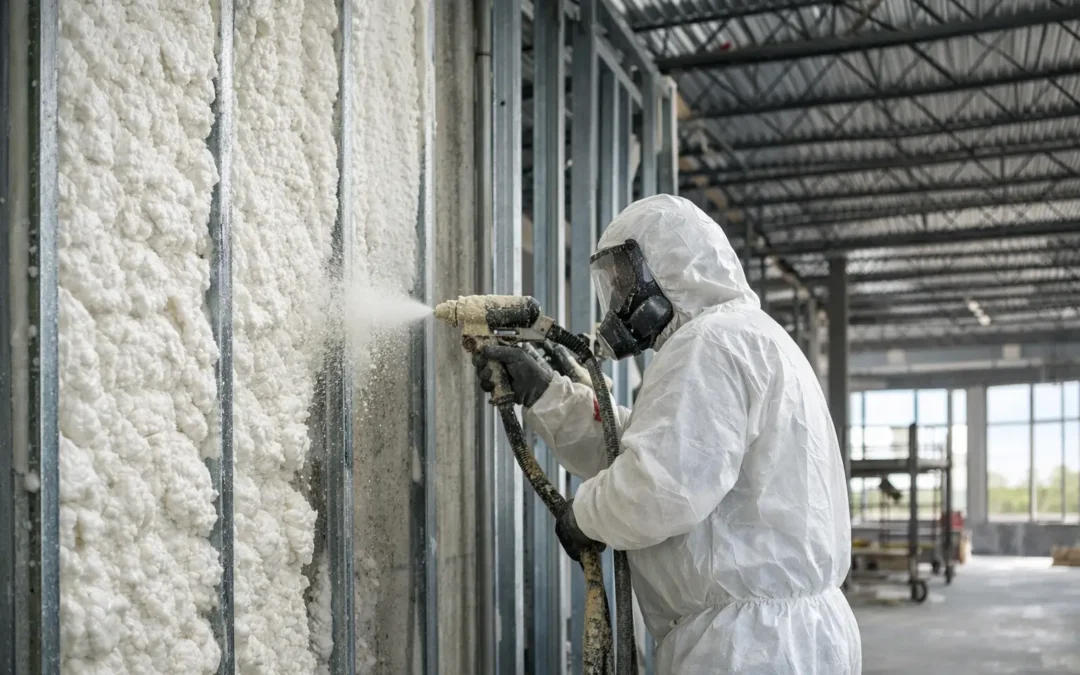
Spray foam expands after application and adheres to the surface it is installed on. That allows it to seal irregular spaces that are difficult to insulate well with batt or loose-fill products alone. The result is a tighter building envelope that supports more stable indoor temperatures and better energy efficiency.
This is where owners often see the real value. The conversation is not only about R-value. It is about controlling the movement of air, moisture, and heat as a system. When the envelope performs better, the HVAC equipment is not fighting the building all day. Occupants are more comfortable, and the building is easier to manage.
Open-cell vs. closed-cell spray foam in commercial projects
Both open-cell and closed-cell spray foam can improve building performance, but they are not interchangeable. The right choice depends on the building type, the assembly, and the goals of the project.
Open-cell spray foam is lighter and expands significantly, which makes it effective for filling wall and roof cavities. It offers strong air sealing and sound control, and it is often used where the assembly needs insulation with some permeability. For certain interior applications, it can be a practical option.
Closed-cell spray foam is denser and delivers a higher R-value per inch. It also adds rigidity and provides stronger resistance to moisture. In many commercial applications, especially where space is limited or where added durability matters, closed-cell foam is the better fit. Metal buildings are a common example because condensation control and thermal performance are both major concerns.
The best answer is not always the same from one project to the next. A retail buildout, a warehouse, and an office building can have very different insulation demands. That is why product selection should be based on the building assembly and performance priorities, not guesswork.
Where commercial buildings benefit most
The biggest gains usually happen where the building has the most exposure to outside conditions or the most opportunity for air leakage. Roof decks, exterior walls, attics, crawl spaces, and rim joists are all common problem areas. In commercial properties with large mechanical penetrations or complex framing, spray foam can solve issues that conventional insulation leaves behind.
Metal buildings deserve special attention. They are popular for commercial and industrial use, but they are also prone to heat gain, heat loss, and condensation if the insulation system is not designed well. Spray foam adheres directly to metal surfaces and helps create a more continuous thermal and air barrier. That can make a dramatic difference in comfort and moisture control.
Office spaces and retail environments benefit for a different reason. Occupant comfort affects productivity, tenant satisfaction, and the overall feel of the space. If one side of the building is hot in the afternoon and another area is drafty in the morning, people notice. Better insulation reduces those swings and supports a more consistent indoor environment.
Energy savings are real, but only when the installation is right
Owners are often interested in spray foam because they want lower utility bills, and that is a valid reason. A building that leaks less air generally requires less energy to heat and cool. But performance depends heavily on proper installation.
Spray foam is not a product that should be treated like a commodity. Surface preparation, application thickness, substrate conditions, and installer experience all affect the final result. Gaps, missed areas, or uneven coverage can reduce the benefit of the system. The material itself is high performance, but the installation has to match.
That is one reason experienced contractors put so much emphasis on evaluating the full building envelope. Insulation should work with the rest of the structure, not in isolation. Roof assemblies, wall systems, ventilation strategy, and mechanical design all influence the outcome.
Moisture control is a major part of the value
Commercial buildings do not only lose energy through poor insulation. They also suffer when moisture gets where it should not be. Condensation inside walls or roof assemblies can lead to mold, material damage, and indoor air quality concerns. Those issues are expensive and disruptive.
Spray foam helps by reducing the air movement that often carries moisture into building cavities. Closed-cell foam in particular adds another layer of protection because of its low permeability and strong resistance to water intrusion. In the right assembly, that can support a healthier and more durable building.
That said, moisture control is never a one-size-fits-all conversation. Climate, occupancy, ventilation, and building design all matter. A good insulation plan takes those factors into account instead of assuming one product solves every problem by itself.
The upfront cost is higher, and that is part of the decision
Spray foam is a premium insulation system. It typically costs more upfront than fiberglass or other conventional options. For some projects, that can be a sticking point, especially when budgets are tight.
But commercial owners usually benefit from looking past the first invoice. If the insulation helps reduce energy use, improves comfort, supports moisture control, and lowers strain on HVAC equipment, the long-term value can be strong. In many buildings, the lower operating costs and better performance justify the higher initial investment.
It also depends on what the project is trying to accomplish. If the goal is the lowest possible installation cost, spray foam may not be the answer. If the goal is a tighter, stronger, more efficient building that performs better year after year, it is often one of the smartest upgrades available.
What to ask before choosing a system
Before moving forward, it helps to ask a few practical questions. Where is the building currently losing energy? Is moisture or condensation already an issue? Are there comfort complaints from tenants or staff? Is the project new construction, a retrofit, or an improvement to a specific area such as a roof deck or metal wall assembly?
Those answers shape the insulation strategy. They also help determine whether open-cell or closed-cell foam is the right fit, how much thickness is needed, and where the building will benefit most from air sealing. A contractor with real commercial insulation experience should be able to walk the site, identify problem areas, and explain the trade-offs clearly.
For commercial property owners in Arizona, local conditions matter too. Heat, sun exposure, and building use patterns all influence performance. A system that looks fine on paper still has to work in the real world.
When spray foam is specified correctly and installed by a qualified contractor, it can do more than improve insulation. It can help create a commercial building that is easier to heat, easier to cool, more comfortable to occupy, and better protected against the problems that come with air leakage and moisture. For owners and builders who want a building envelope that works as hard as the rest of the property, that is a worthwhile place to start the conversation.