Metal buildings are tough, fast to build, and versatile – but they can be brutally unforgiving when they are insulated the wrong way. A steel shell heats up fast in the Arizona sun, sheds heat quickly on cold nights, and can create serious condensation problems if the insulation system does not control both temperature and air movement. That is why any real guide to insulating metal buildings has to start with building performance, not just R-value on a product label.
If you own a shop, warehouse, barndominium, garage, or agricultural building, the goal is simple: create a structure that stays more comfortable, wastes less energy, and does not invite moisture damage. The best insulation choice depends on how the building is used, how often it is conditioned, and how much long-term performance matters compared to upfront cost.
Why metal buildings need a different insulation strategy
Metal behaves differently than wood framing. Steel transfers heat quickly, and that makes temperature swings inside the building more extreme. When warm, humid air contacts a cooler metal surface, condensation can form. Over time, that moisture can lead to dripping, rust, mold growth on interior finishes, and damage to anything stored inside.
That is the core issue many property owners miss. Insulating a metal building is not only about slowing heat flow. It is also about controlling air leakage and moisture migration. If you only add a material that looks thick but does not air seal, you can still end up with drafts, hot spots, cold spots, and sweating metal panels.
This is one reason spray foam stands out in metal building applications. It insulates and air seals in one step, which helps address the two biggest performance problems at the same time.
Guide to insulating metal buildings by building use
The right system for a storage-only building is not always the right system for a workshop, office, or finished living space. Usage matters.
For an unconditioned storage building, the main concern may be condensation control rather than maximum thermal performance. In that case, a basic insulation approach may be enough if it limits moisture problems and reduces heat gain.
For a workshop or commercial space that is heated or cooled regularly, insulation needs to do more. You want steady indoor temperatures, lower HVAC demand, and fewer drafts. Air sealing becomes much more important here because even a good heater or air conditioner cannot keep up efficiently if outside air is constantly leaking in.
For a barndominium or any occupied living area, insulation has to support full building-envelope performance. Comfort, indoor air quality, moisture control, and long-term energy savings all matter. This is where premium insulation systems usually make the most financial sense over time.
The most common insulation options for metal buildings
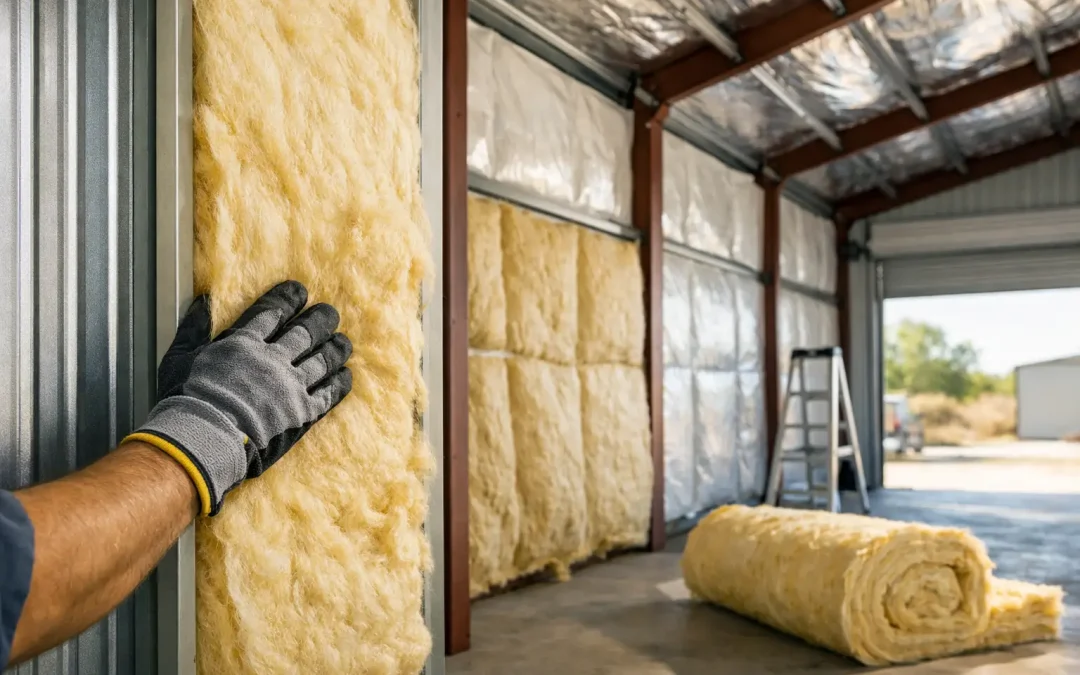
Fiberglass is often chosen because of lower upfront cost. In metal buildings, it is commonly installed as blanket insulation or batt systems. Fiberglass can help reduce heat transfer, but it does not stop air movement on its own. If installation is loose, compressed, or interrupted around framing and penetrations, performance drops. In a metal building, that gap between rated performance and real-world performance can be significant.
Rockwool can offer better density and sound control than fiberglass, and it handles heat well. It can be a solid choice in certain assemblies, especially where fire resistance is part of the equation. Still, like fiberglass, it is not an air barrier by itself. It usually performs best when paired with a well-designed assembly that addresses air leakage separately.
Spray foam is the premium option because it combines insulation with air sealing. Closed-cell spray foam is especially effective in metal buildings because it adheres directly to the metal surface, helps reduce condensation risk, and delivers a higher R-value per inch than many traditional materials. It also adds rigidity to the assembly, which can be a meaningful benefit in some structures.
Open-cell spray foam can work in specific interior applications, but for metal buildings, closed-cell is often the stronger fit when moisture control and high performance are priorities. The exact recommendation depends on the building design and use.
Why spray foam often performs better in metal buildings
A metal building has a lot of opportunities for unwanted air movement. Roof seams, wall joints, fastener penetrations, trim transitions, and framing connections all create pathways for outside air. Traditional insulation may slow heat flow, but if air still moves through or around the assembly, comfort and efficiency suffer.
Closed-cell spray foam addresses that problem directly. It bonds to the underside of roof and wall panels, creating continuous coverage that helps block air leakage while insulating the structure. That matters in hot climates, cold snaps, and every season in between.
Moisture control is another major advantage. Because spray foam limits contact between humid interior air and cooler metal surfaces, it helps reduce the chance of condensation. That can protect the building itself and everything inside it, from equipment and tools to finished interiors and inventory.
The trade-off is cost. Spray foam usually costs more upfront than fiberglass systems. But when property owners look at lower energy bills, better comfort, reduced moisture risk, and fewer performance problems over time, the value often becomes clear.
Common mistakes that lead to poor results
One of the biggest mistakes is choosing insulation based on price alone. Low-cost material can become expensive if the building stays uncomfortable, develops condensation, or forces the HVAC system to work harder year after year.
Another common problem is ignoring the role of air sealing. A metal building can be insulated and still feel drafty if the assembly leaks air. That is why product selection and installation quality both matter.
Ventilation mistakes also create trouble. Some buildings need a specific balance between insulation, air sealing, and ventilation to manage humidity properly. More ventilation is not always better, and less is not always better either. It depends on how the building is used and whether it is conditioned.
Finally, thin or uneven installation causes underperformance. Metal buildings have lots of corners, framing transitions, and hard-to-reach areas. If insulation is skipped or reduced in those zones, they can become thermal weak points that affect the entire building.
How to choose the right insulation system
Start with the building’s purpose. Ask whether the space will be occupied daily, whether it will be heated or cooled year-round, and whether moisture-sensitive materials will be stored inside. Those answers narrow the field quickly.
Then look at your priorities. If the goal is the lowest possible upfront cost for a lightly used building, fiberglass may be acceptable in some cases. If the goal is long-term comfort, lower utility costs, condensation control, and a tighter building envelope, spray foam is usually the better investment.
Climate should also factor into the decision. In Arizona, metal buildings can take on intense solar heat during the day and cool rapidly at night. That swing puts pressure on the insulation system. A product that only handles part of the problem may not deliver the results owners expect.
This is also where working with an experienced insulation contractor matters. Metal building insulation is not just about filling cavities. It is about choosing an assembly that fits the structure, the climate, and the way the building will actually be used.
What good insulation should deliver
A properly insulated metal building should feel noticeably more stable inside. Rooms should stay more consistent from morning to evening. HVAC equipment should run more efficiently. Drafts should be reduced, and surfaces should be less prone to sweating.
You should also see long-term benefits that are easy to overlook at first. Better insulation can help protect finishes, reduce strain on equipment, improve indoor air quality, and make the building more functional year-round. For commercial owners, that can translate into lower operating costs and a better space for employees or tenants. For homeowners and barndominium owners, it often means better comfort and fewer headaches.
At Ridgetopp Insulation, we have seen the difference that the right insulation system makes in metal buildings across Arizona conditions. The biggest improvements usually come when owners stop treating insulation as a basic add-on and start treating it as part of the building’s performance system.
If you are planning a new metal building or trying to fix one that is too hot, too cold, or constantly fighting moisture, focus on results rather than just material cost. The right insulation should do more than fill space between surfaces. It should help the whole building work better every day.