
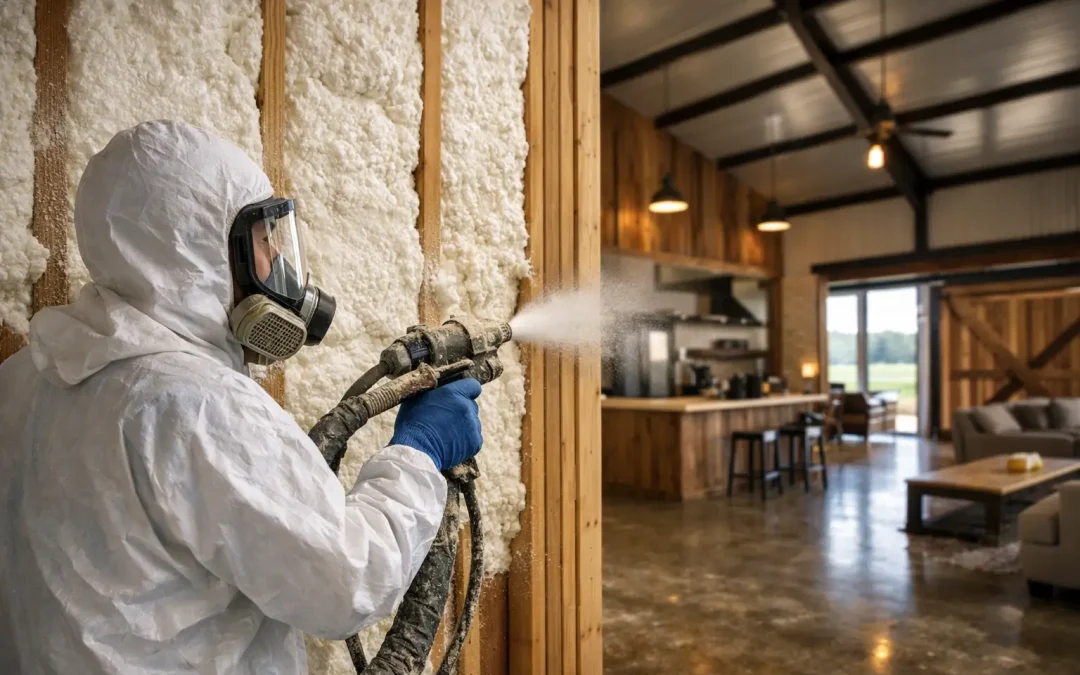
A barndominium can look simple from the outside – a metal shell, wide-open interior, and a roof built to handle the elements. But that same metal structure can become brutally hot in summer, cold at night, noisy in rain, and vulnerable to condensation if the insulation system is not designed correctly. Spray foam for barndominiums addresses those problems at the source by insulating and air sealing the building envelope in one application.
For Arizona property owners and builders, this is more than a comfort upgrade. A properly insulated barndominium puts less strain on heating and cooling equipment, helps protect metal surfaces from moisture, and makes the finished space feel like a home rather than a converted shop.
Why Barndominiums Need More Than Basic Insulation
Metal buildings behave differently than wood-framed homes. Steel framing and roof panels transfer heat quickly, which means outdoor temperatures can affect indoor comfort fast. If outside air can move through gaps at the roofline, wall connections, penetrations, or around framing, conventional insulation alone may not stop the problem.
Fiberglass batts can provide thermal resistance, but they do not air seal. When air moves around or through the insulation, the effective performance drops. In a barndominium, that can lead to hot rooms, cold corners, dusty indoor air, and higher utility bills.
Condensation is another major concern. Warm, humid indoor air that reaches a cold metal surface can create moisture. Over time, that moisture may contribute to corrosion, mold growth on adjacent materials, damaged finishes, and a damp indoor environment. Insulation must be part of a complete moisture-control strategy, not simply material placed between studs.
Spray foam adheres directly to the underside of roof decking, metal wall panels, and framing cavities. It fills irregular gaps that are hard to address with batt insulation, creating a more continuous thermal and air-control layer.
Open-Cell vs. Closed-Cell Spray Foam for Barndominiums
Both types of spray foam outperform conventional insulation when installed correctly, but they serve different purposes. The right choice depends on the building assembly, local conditions, available cavity depth, and the owner’s priorities.
Open-Cell Foam: Strong Air Sealing and Sound Control
Open-cell spray foam expands significantly after application, allowing it to fill cracks, seams, and hard-to-reach areas. It is often used in walls, rooflines, and interior assemblies where a high-performing air seal and sound reduction are priorities.
For a finished barndominium living space, open-cell foam can make a noticeable difference in comfort. It reduces air movement that causes drafts and helps soften noise from rain, wind, equipment, and activity in adjacent rooms. Because it expands into irregular spaces, it is especially effective around roof framing and complicated transitions.
Open-cell foam is vapor permeable, so it is not the best fit for every metal-building application. Where moisture resistance or a vapor retarder is necessary, closed-cell foam may be the better solution.
Closed-Cell Foam: Maximum R-Value and Moisture Resistance
Closed-cell spray foam is denser and delivers a higher R-value per inch than open-cell foam. It also resists moisture and adds strength to the assembly. In barndominiums with limited cavity depth, metal surfaces, or areas exposed to higher moisture risk, those qualities are valuable.
Applied directly to metal, closed-cell foam can help reduce the risk of condensation by limiting the contact between humid interior air and cold metal. It is commonly considered for exterior walls, roof decks, crawl spaces, workshops, and other areas where moisture control is a primary concern.
Closed-cell foam generally costs more upfront than open-cell foam. However, the added thermal performance, air sealing, and moisture resistance can make it a smart long-term investment, particularly in a structure with extensive metal framing and roofing.
The Biggest Benefits of Spray Foam in a Barndominium
The strongest case for spray foam is not just its R-value. It is the way it improves the overall building envelope. A barndominium is full of joints, fasteners, framing intersections, roof penetrations, and transitions where unwanted air can enter. Spray foam helps close those pathways.
First, it improves temperature consistency. Rooms are less likely to swing from too hot to too cold as outdoor conditions change. That matters in the Rim Country, where a warm afternoon can turn into a cold evening quickly.
Second, it can lower heating and cooling demand. A home that leaks less conditioned air requires less work from the HVAC system. Actual savings depend on the building size, equipment, thermostat settings, window performance, and existing insulation, but air sealing is one of the most effective ways to reduce energy waste.
Third, spray foam supports better moisture management. This is particularly important beneath metal roofing and on metal wall assemblies, where condensation can become an expensive hidden problem. Closed-cell foam can provide an added layer of protection where the assembly calls for it.
Finally, spray foam can improve indoor air quality. By reducing uncontrolled air leakage, it helps limit the entry of dust, pollen, outdoor pollutants, and insects. A tighter home should also have properly planned ventilation, especially when the home is highly air sealed. Fresh-air ventilation and moisture control should be considered alongside insulation, not after the fact.
Where Spray Foam Makes the Most Sense
A full spray foam system is often the best-performing approach for a finished barndominium, but every building does not need the same configuration. The roofline is usually the most important area to evaluate because it is a major source of heat gain, heat loss, and air leakage.
Spraying the underside of the roof deck can bring ductwork and mechanical equipment into a more conditioned environment when the design supports an unvented roof assembly. This can improve HVAC performance and keep the indoor envelope more consistent. It also creates a cleaner, more usable attic area compared with a vented attic packed with loose-fill insulation.
Wall cavities are another high-value area, especially where steel framing creates thermal bridging. Spray foam helps seal around framing and penetrations, although it does not eliminate every thermal bridge created by metal. A qualified insulation contractor can recommend whether additional continuous insulation is needed to improve the wall assembly.
Workshops, garages, attached storage areas, crawl spaces, and bonus rooms should not be overlooked. If these spaces share walls or ceilings with conditioned living areas, poor insulation and air leakage can affect the comfort of the entire home.
Installation Quality Matters as Much as the Product
Spray foam is a premium insulation system, but its performance depends on correct installation. The substrate must be clean and dry, the foam must be applied at the proper thickness, and the installer must understand how the roof, walls, ventilation, and mechanical systems work together.
An experienced contractor will inspect the metal building design before recommending a foam type or thickness. They should account for roof configuration, local climate, interior humidity, wall and roof assemblies, electrical and plumbing penetrations, and code requirements. Fire-protection coatings or ignition barriers may also be required depending on where the foam is installed and how the space will be used.
Avoid making the decision based on the lowest price per square foot. Thin or inconsistent application, poor surface preparation, and an insulation plan that ignores condensation risk can cost far more to correct later. The right installation protects the building’s performance for years, not just until the project is closed in.
Is Spray Foam Worth the Cost?
Spray foam costs more than fiberglass at the time of installation. That is the trade-off. But comparing material prices alone misses what a barndominium owner is buying: insulation, air sealing, improved moisture control, reduced drafts, and a more stable indoor environment.
For a conditioned residence, that performance often justifies the investment. It is especially compelling when the project includes metal roofing, vaulted ceilings, HVAC equipment in the attic, difficult framing details, or a goal of keeping utility costs under control over the life of the building.
A hybrid approach can also make sense. For example, closed-cell foam may be used where moisture resistance and higher R-value per inch matter most, while open-cell foam may be used in suitable interior roof or wall areas. The best plan is the one that matches the building, not a one-size-fits-all package.
A barndominium should feel solid, quiet, and comfortable in every season. When the insulation system is designed around air sealing, thermal performance, and moisture control from the beginning, spray foam helps turn a metal structure into a home built to perform.