
If your floors feel cold in winter, your home smells damp after monsoon season, or your HVAC seems to run nonstop, the space under your house may be part of the problem. Learning how to spray foam insulation under house areas starts with one key fact: this is not just about adding R-value. It is about air sealing, moisture control, and protecting the building from below.
In Arizona, crawl spaces and raised-floor homes deal with a mix of heat, dust, seasonal moisture, and outside air moving where it should not. Traditional insulation under the floor can sag, absorb moisture, and leave gaps. Spray foam changes that equation because it seals and insulates in one application. Done correctly, it can make floors more comfortable, reduce energy loss, and help create a cleaner, healthier indoor environment.
Where spray foam goes under a house
When people ask how to spray foam insulation under house framing, they are usually talking about one of two areas: the underside of the floor system or the crawl space walls. The right approach depends on how the house is built and how the crawl space is being managed.
If the crawl space is vented and staying vented, spray foam is often applied to the underside of the subfloor between and across the floor joists. This keeps the thermal boundary at the floor level. If the crawl space is being brought into the conditioned envelope, insulation is usually moved to the perimeter walls instead. That approach can work extremely well, but it changes how the space handles air and moisture, so it needs a plan.
This is where many DIY articles fall short. They make it sound like you simply point and spray. In reality, the best location for foam depends on venting, existing moisture conditions, access, mechanical systems in the crawl space, and the type of foam being used.
Open-cell vs. closed-cell under a house
Closed-cell spray foam is usually the stronger fit under a house, especially in crawl spaces or floor systems exposed to temperature swings and moisture risk. It delivers a higher R-value per inch, adds rigidity, and resists water far better than open-cell foam. It also creates a more effective air barrier at the proper thickness.
Open-cell foam has its place, but under a house it is often less ideal because it is softer and more vapor permeable. In a dry assembly with the right design, it can perform well. But if the goal is premium performance, moisture resistance, and long-term durability, closed-cell is typically the better choice.
That does not mean thicker is always better. Foam depth needs to match the assembly, climate considerations, and code requirements. Too little leaves performance on the table. Too much in the wrong place can create drying issues or unnecessary cost.
How to prepare before spraying
The prep work matters as much as the foam itself. Before any insulation goes in, the area under the house should be inspected for bulk water, plumbing leaks, signs of wood rot, pest activity, loose wiring, and old insulation that has failed. Spray foam should never be used to cover an active problem and pretend it is fixed.
If old fiberglass batts are hanging down, wet, or dirty, they should be removed. The subfloor and framing need to be reasonably clean and dry so the foam can adhere correctly. In a crawl space, ground moisture should also be addressed. If there is exposed soil, a vapor barrier may be necessary as part of the overall system.
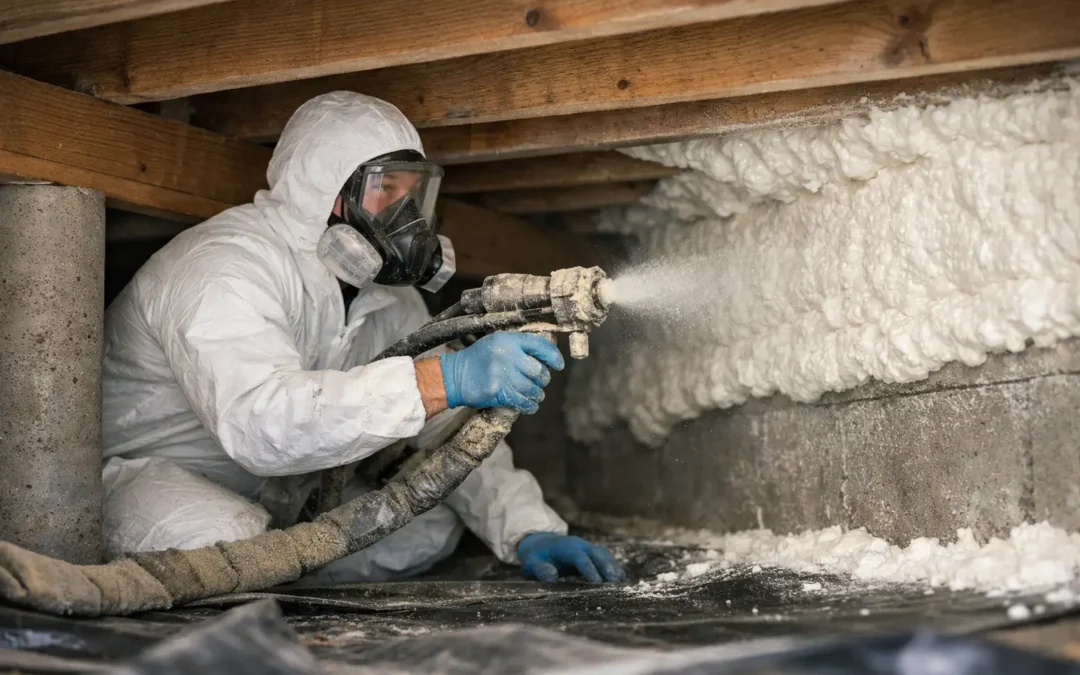
Access and safety are also real issues. Crawl spaces can be tight, dusty, and difficult to ventilate during installation. Professional crews use protective equipment and control the work area because spray foam chemicals must be handled carefully during application and curing.
How to spray foam insulation under house floor systems
If the plan is to insulate the underside of the floor, the foam is typically applied directly to the subfloor and along the sides of the joists to create continuous coverage. The goal is not just to fill cavities. The goal is to stop air movement and maintain consistent contact with the surface being insulated.
Coverage needs to be even. Gaps, thin spots, or missed rim areas can compromise the whole job. Penetrations around pipes, wiring, and ducts should be sealed as part of the application. These small leakage points are often where a lot of comfort and energy loss happens.
Spraying in lifts is important, especially with closed-cell foam. Applying too much at once can affect curing and adhesion. Professional installers build up the foam to the required thickness in controlled passes, checking for consistent expansion and bond.
It is also important to protect components that should not be buried in foam. Heat-producing fixtures, certain wiring conditions, access panels, and serviceable mechanical elements may need clearance or a different treatment. This is one reason contractor experience matters.
When crawl space walls make more sense
In some homes, insulating the crawl space walls is the smarter upgrade. If ducts, plumbing, or air handlers are located in the crawl space, bringing that area closer to indoor conditions can improve system efficiency and reduce temperature extremes under the house. It can also help protect pipes and reduce condensation risk.
But this approach works best when the crawl space is treated as part of the building envelope, not as a half-conditioned afterthought. Vents may need to be closed, the earth may need a proper vapor barrier, and moisture management needs to be intentional. Simply spraying the walls and walking away is not enough.
For homeowners, the takeaway is simple: insulating under the floor and insulating the crawl space walls are not interchangeable choices. Each solves a different building-performance problem.
Common mistakes that hurt performance
The biggest mistake is treating spray foam like a patch instead of a system. If there is standing water, high crawl space humidity, or poor drainage around the home, foam alone will not solve it. Those conditions need to be corrected first.
Another mistake is choosing foam based only on price. Low-cost kits and thin applications can leave major air leaks in place. You may technically have foam under the house, but not enough to deliver the comfort, efficiency, or moisture control you expected.
Poor surface prep, spraying over dirty or damp materials, and ignoring combustion or ventilation requirements can also create serious problems. Under-house insulation is one of those areas where shortcuts usually show up later as cold floors, musty odors, higher bills, or callbacks.
DIY vs. professional installation
Homeowners can buy spray foam kits, and for very small rim joist or repair projects, that may be reasonable. But insulating an entire under-house area is different. The work is awkward, chemistry-sensitive, and highly dependent on technique.
A professional installer can evaluate whether the floor system or crawl space walls should be insulated, select the right foam type, apply it at the correct thickness, and spot issues a DIY job might miss. That matters because the payoff from spray foam comes from precision. If the air barrier is incomplete, the performance drops fast.
For many homes, especially older raised-floor homes or properties with crawl space moisture concerns, professional installation is the safer investment. It costs more upfront than fiberglass, but it usually delivers much better long-term results.
What kind of results should you expect?
When spray foam is properly installed under a house, the first thing most people notice is comfort. Floors feel less cold. Drafts decrease. Rooms hold temperature more consistently. In many cases, utility costs improve because the HVAC system is not fighting outside air leaking through the floor assembly.
You may also notice less dust movement and fewer musty odors if the crawl space had air leakage issues before. That is one of the biggest strengths of spray foam. It does more than insulate. It tightens the building from one of its most overlooked weak points.
For homeowners in places like Payson and across Arizona’s mixed climates, that can mean better year-round performance, not just a warmer floor on a cold morning.
Is spray foam under a house worth it?
If the area under your home is contributing to comfort issues, moisture concerns, or rising energy bills, spray foam is often worth serious consideration. It is a premium insulation solution, and it should be approached that way. The right design, the right foam, and the right installer make all the difference.
If you are researching how to spray foam insulation under house assemblies, the smartest next step is not guessing at product thickness or kit size. It is figuring out how your home is currently performing from below and choosing an insulation strategy that fixes the real problem. When that happens, the result is not just more insulation. It is a stronger, tighter, healthier home.