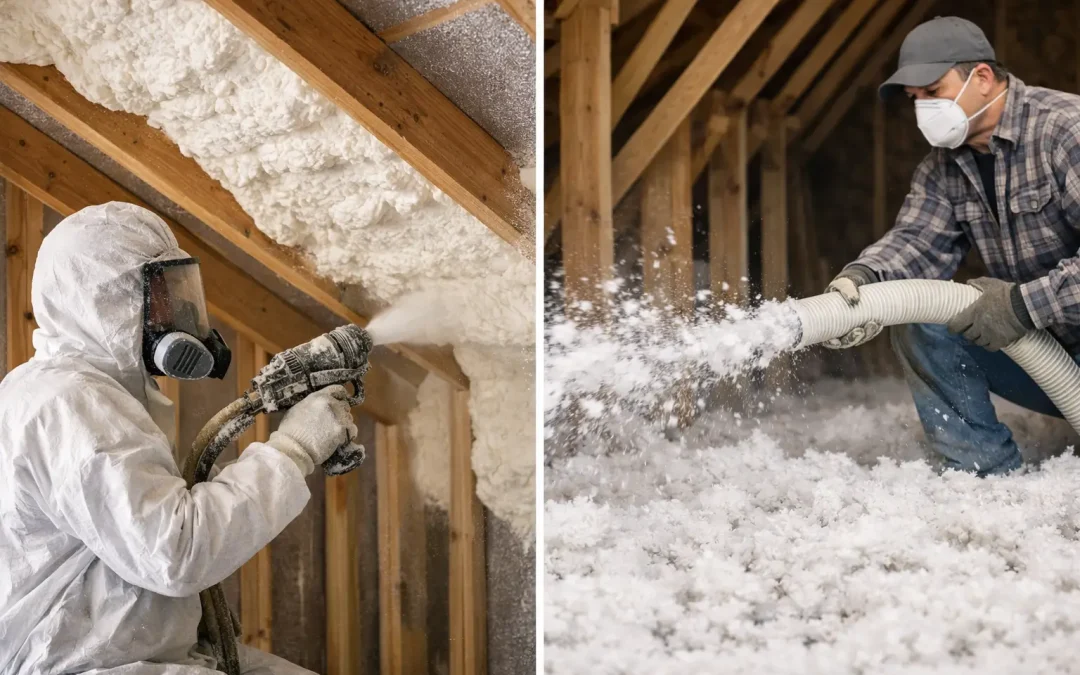
When a house feels drafty in winter, overheats in summer, or runs the HVAC system nonstop, the insulation choice stops being abstract. That is where spray foam versus blown insulation becomes a real decision with long-term consequences for comfort, energy use, and building performance.
Both products can improve efficiency. Both have a place in residential and commercial construction. But they do not perform the same way, and treating them as interchangeable usually leads to disappointing results. If you want the shortest answer, spray foam is the higher-performing system because it insulates and air seals at the same time. Blown insulation can still be a solid option in the right space, especially when budget is the main driver, but it does not solve air leakage on its own.
Spray foam versus blown insulation: the core difference
The biggest difference is simple. Spray foam creates an insulated air seal. Blown insulation mainly adds thermal resistance.
That distinction matters more than many property owners realize. Heat does not move through a building only by conduction through materials. It also escapes through air movement around gaps, penetrations, framing transitions, top plates, rim joists, duct openings, and wiring runs. If those leaks remain, even a decent R-value can underperform.
Spray foam expands in place and adheres to the substrate. That lets it fill cracks, irregular cavities, and hard-to-seal areas that other insulation types often leave exposed. Blown insulation, whether fiberglass or cellulose, is effective at covering open attic floors and adding depth, but it does not stop uncontrolled airflow unless a separate air-sealing step is completed first.
How spray foam performs in the real world
Spray foam is typically installed as either open-cell or closed-cell foam. Both options outperform conventional insulation in air leakage control, but they are used a little differently depending on the assembly and the goals of the project.
Open-cell spray foam is lighter and more flexible. It is often used in walls, roof decks, and interior areas where air sealing and sound control matter. Closed-cell spray foam is denser and offers a higher R-value per inch. It also adds rigidity and stronger moisture resistance, which makes it useful in areas where space is limited or where extra durability is needed.
For homeowners, the benefits show up quickly. Rooms feel more even from one end of the house to the other. Drafts are reduced. HVAC systems cycle less aggressively. Dust and outdoor pollutants have fewer pathways indoors. In many cases, the house simply feels tighter, quieter, and easier to keep comfortable.
For builders and commercial property owners, spray foam helps create a more controlled building envelope. That can support better energy performance, improved moisture management, and fewer callbacks related to hot rooms, condensation, or comfort complaints.
Where blown insulation still makes sense
Blown insulation is not a bad product. It is just a different product with different strengths.
In open attic floors, fiberglass blown-in insulation can be a practical and cost-effective way to increase R-value over existing living space. It is commonly used when an attic already has decent air sealing or when the goal is to improve thermal performance without a full building-envelope upgrade. It can also be a reasonable fit for projects where budget is tight and the owner wants a lower upfront cost.
That said, blown insulation works best when expectations are realistic. If the attic floor has bypasses around can lights, bath fans, plumbing penetrations, or framing joints, adding more blown insulation alone will not stop the drafts or energy loss caused by air movement. It can cover the problem without fixing it.
This is one of the most common reasons people add insulation and still feel disappointed afterward. The depth improved, but the leakage remained.
Cost versus value
If the decision is based only on upfront price, blown insulation usually wins. It is generally less expensive to install than spray foam, especially in simple attic applications.
But most property owners are not really deciding between cheap and expensive. They are deciding between lower first cost and higher long-term performance.
Spray foam typically costs more because it does more. It combines insulation with air sealing in one application. In many assemblies, that reduces energy waste more effectively than adding a thicker layer of conventional insulation. Over time, the benefits can include lower heating and cooling costs, better indoor comfort, fewer moisture-related issues, and less strain on HVAC equipment.
That does not mean spray foam is automatically the right answer for every square foot of every building. It does mean the comparison should be based on total building performance, not just install price.
Moisture control changes the conversation
In Arizona, insulation decisions are often framed around heat gain and utility bills. That is fair, but moisture control still deserves attention.
Air leakage carries moisture. When warm, humid air moves through building cavities and contacts cooler surfaces, condensation risk goes up. Over time, that can contribute to mold, material damage, and poor indoor air quality.
Spray foam helps limit that risk by restricting air movement at the source. Closed-cell foam adds another level of protection because of its low permeability and resistance to water intrusion. That makes it especially valuable in crawl spaces, metal buildings, and other assemblies where moisture control is part of the performance equation.
Blown insulation does not provide that same level of protection on its own. It can be part of a well-designed system, but it is not an air barrier. In moisture-sensitive areas, that distinction matters.
Spray foam versus blown insulation in attics
Attics are where this comparison comes up most often, and the right answer depends on how the attic is being used.
If the insulation stays on the attic floor and the attic remains vented, blown insulation can improve performance at a lower cost. This is common in homes where the attic is outside the conditioned envelope and there is no reason to bring it inside.
If you want to create a tighter, more efficient envelope, spray foam at the roof deck changes the strategy. Instead of insulating the floor of the attic, the roofline is insulated and air sealed. That can make a major difference when ductwork or mechanical equipment is located in the attic, which is common in many homes. By reducing the extreme heat load in that space, spray foam can improve HVAC efficiency and indoor comfort in ways blown insulation on the attic floor often cannot match.
This is a good example of why the best insulation choice depends on the assembly, not just the product name.
What builders and homeowners should really ask
A better question than Which insulation is best is What problem are you trying to solve?
If the goal is simply to add R-value in an open attic at the lowest price, blown insulation may be enough. If the goal is to reduce drafts, tighten the envelope, improve moisture control, and get stronger overall performance, spray foam is usually the better solution.
That is why many high-performance homes and commercial buildings lean toward spray foam in critical areas. It addresses the leaks and gaps that drive a surprising share of energy loss. It also helps create buildings that feel better to live and work in, not just buildings that look better on paper.
At Ridgetopp Insulation, that difference is central to how insulation is evaluated. The best results come from matching the product to the building, the climate, and the performance goals instead of chasing the lowest bid.
The decision comes down to priorities
There is no honest comparison where blown insulation beats spray foam on overall air sealing and whole-envelope performance. It does not. Spray foam is the premium option because it solves more than one problem at once.
Still, blown insulation has a place when the assembly is straightforward and the budget points in that direction. The key is understanding what you are getting and what you are not. More insulation depth is helpful. A sealed building envelope is better.
If your priority is long-term comfort, lower energy waste, stronger moisture protection, and a healthier indoor environment, spray foam usually delivers the stronger return. If your priority is the lowest upfront investment for a basic thermal upgrade, blown insulation may fit.
Good insulation decisions are not about buying the most material. They are about getting the right performance where the building needs it most.