
A home can have plenty of insulation and still feel cold near the floor in winter, hot upstairs in summer, or dusty whenever the HVAC turns on. That usually points to uncontrolled air movement, not simply a lack of R-value. In the spray foam vs cellulose decision, that difference matters because the two materials manage heat, air, and moisture in very different ways.
Cellulose can be an effective, cost-conscious choice for certain attic projects. Spray foam is the higher-performance building-envelope solution when air sealing, moisture control, and dependable long-term comfort are priorities. The right answer depends on where the insulation is going, how the building is constructed, and what problem you need it to solve.
Spray Foam vs Cellulose at a Glance
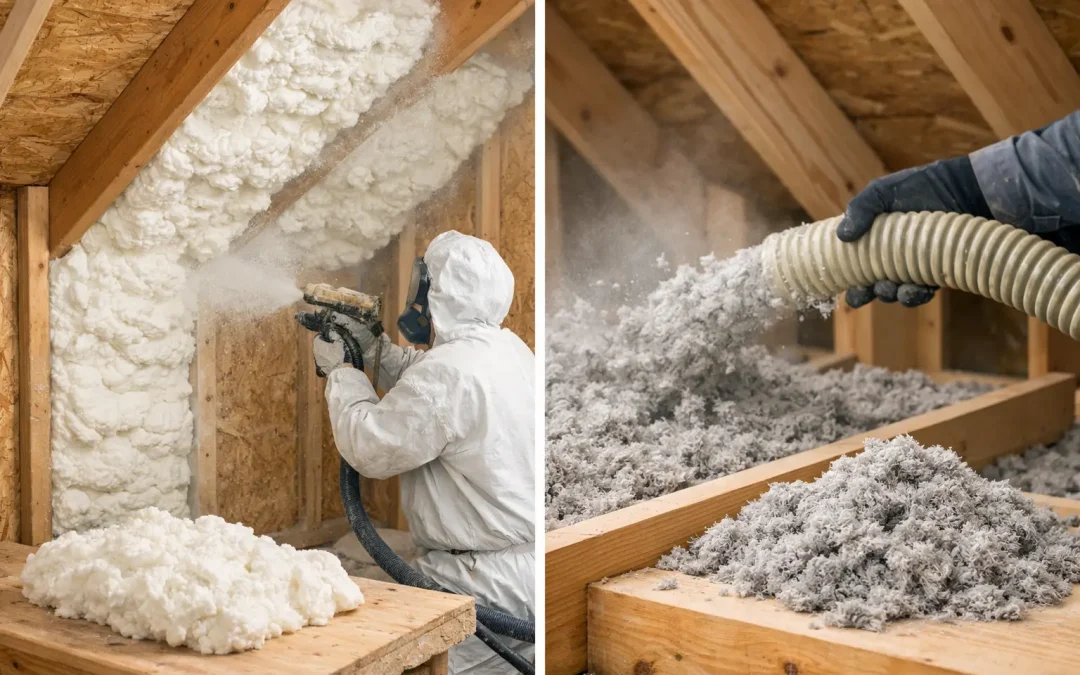
Cellulose is a loose-fill insulation typically made from recycled paper fibers treated with borates for fire resistance and pest deterrence. It is commonly blown into open attics, wall cavities, and enclosed floor assemblies. Its primary job is slowing heat flow through its R-value.
Spray polyurethane foam is applied as a liquid that expands in place. It fills gaps around framing, wiring, plumbing penetrations, and irregular surfaces while providing insulation. That gives it a major advantage: spray foam can air seal and insulate in the same application.
For a simple attic where the goal is to add depth over an existing ceiling plane, blown cellulose may make sense. For a roof deck, crawl space, metal building, or structure with persistent drafts and moisture concerns, spray foam is usually the stronger system.
Air Sealing Is the Biggest Performance Difference
Insulation works best when air is not moving through or around it. Air leaks carry heat, outdoor dust, humidity, and pollutants into a building. In Arizona’s high-country climate, those leaks can make heating systems work harder on cold Rim Country nights and allow unwanted heat into a home during the cooling season.
Cellulose is denser than fiberglass and does a better job of slowing airflow through the insulation itself. Dense-packed cellulose can reduce air movement inside a wall cavity, but it does not create a continuous air barrier. Air can still pass through gaps at top plates, bottom plates, attic penetrations, rim joists, and other transitions unless those areas are sealed separately.
Spray foam adheres directly to the surface it covers and expands into small openings. When installed correctly, it creates a continuous air seal across the assembly. That is why homeowners often notice fewer drafts, more even room temperatures, and less outdoor dust after a spray foam project. The performance gain is not just about a higher R-value per inch. It is about stopping conditioned air from escaping in the first place.
R-Value: More Insulation in Less Space
R-value measures resistance to heat flow. Cellulose generally provides roughly R-3.2 to R-3.8 per inch, depending on the product and installation method. It can deliver good thermal performance when installed at the proper depth and density.
Open-cell spray foam typically provides about R-3.5 to R-4 per inch. Closed-cell spray foam provides approximately R-6 to R-7 per inch, making it one of the best options when cavity depth is limited. A two-by-four wall, cathedral ceiling, or metal building frame may not have room for a thick layer of loose-fill insulation. Closed-cell foam can deliver substantial thermal resistance without giving up usable space.
That does not mean closed-cell foam belongs everywhere. Open-cell foam can be an excellent choice for interior walls and roof decks where air sealing, sound control, and lower material use are desired. The best foam type depends on the assembly, local climate conditions, and whether vapor control is required.
Moisture Control Changes the Conversation
Moisture problems often begin with air leaks. Warm, moisture-laden indoor air can reach cold surfaces and condense. Outside humidity can also enter through gaps in the building enclosure. Over time, that moisture can contribute to mold, wood damage, odors, and declining insulation performance.
Cellulose can absorb and release some moisture without immediate damage, but it should not be relied on as a moisture-control layer. If a roof leak, plumbing leak, or condensation issue wets cellulose, the material may settle, lose performance, or need to be removed. Wet insulation also deserves prompt investigation because the source of the moisture matters as much as the damaged material.
Closed-cell spray foam resists water and functions as a vapor retarder at the appropriate thickness. It is especially valuable in crawl spaces, beneath roof decks where the assembly calls for it, and metal buildings where condensation can be a recurring concern. Open-cell foam is air-impermeable at the proper thickness but remains vapor-permeable, so it must be selected and detailed with the full building assembly in mind.
No insulation product fixes an active roof leak or drainage problem. A professional insulation plan should identify those issues first, then specify materials that support a dry, durable structure.
Cost: Upfront Price Versus Total Value
Cellulose usually has a lower upfront installation cost than spray foam, particularly in a straightforward open attic. It is a practical way to increase attic R-value where air sealing has already been addressed and access is easy.
Spray foam costs more because the materials, equipment, preparation, and trained installation process are more involved. The investment can be justified when it replaces multiple steps: air sealing, insulating, and in some applications, moisture control. It can also reduce the burden on heating and cooling equipment by improving the entire building envelope.
The lowest bid is not always the lowest lifetime cost. An inexpensive insulation upgrade may leave the largest leaks untouched, allowing comfort complaints and high utility bills to continue. On the other hand, installing premium spray foam in an area that only needs additional attic depth may not be the best use of a project budget. Good recommendations begin with the condition of the structure, not a one-size-fits-all material preference.
Where Each Material Makes Sense
Cellulose is often a strong fit for accessible, vented attics. If the attic floor is the thermal boundary and the home has adequate ventilation above it, blown cellulose can add R-value efficiently. Before installation, major ceiling penetrations, duct chases, recessed fixtures, and top-plate gaps should be air sealed. Otherwise, the new insulation may cover leaks without solving them.
Spray foam is particularly effective in difficult-to-seal spaces. Roof decks, crawl spaces, rim joists, cantilevered floors, irregular framing, and metal buildings all benefit from foam’s ability to conform to the surface and seal transitions. It can also be the better choice when homeowners want to bring ductwork or mechanical equipment inside the conditioned envelope.
For walls, the decision often depends on whether the cavity is open or enclosed. New construction and major renovations allow spray foam to be installed directly in exposed framing. Existing enclosed walls may be candidates for dense-pack cellulose when access is limited, though the building should be evaluated for existing moisture issues before any cavity is filled.
Installation Quality Matters More Than Product Labels
Both materials need proper installation to perform as intended. Cellulose must be installed at the correct depth and density to avoid settling and missed areas. Spray foam must be mixed, applied, and trimmed by trained installers following manufacturer requirements. Poorly installed foam can have voids, inconsistent thickness, or adhesion problems that compromise performance.
Building science also matters. A home with atmospheric-combustion equipment, unvented fuel-burning appliances, or existing ventilation concerns needs a thoughtful approach before major air sealing. As a building becomes tighter, mechanical ventilation and combustion safety may need to be evaluated. A healthier home is not just a tighter home – it is a home with controlled fresh air and properly operating systems.
Which Insulation Should You Choose?
Choose cellulose when you need an economical R-value upgrade in a properly prepared open attic or an existing wall cavity where dense packing is appropriate. It is a proven insulation material, and it can perform well in the right location.
Choose spray foam when drafts, uneven temperatures, moisture exposure, limited cavity space, or complex framing are part of the problem. Its air-sealing capability gives it an advantage that conventional loose-fill insulation cannot duplicate on its own. For homeowners and builders focused on lower energy use, stronger moisture protection, and lasting comfort, that advantage can be substantial.
The best next step is not choosing from a product chart. It is evaluating where your building is losing air, heat, and comfort. A site-specific insulation assessment can show whether cellulose is enough for the job or whether a spray foam system will deliver the performance your property needs.