A beautiful older home can still feel miserable when the attic is working against it. In Arizona, hot summer roof temperatures, cold Rim Country nights, and high heating and cooling costs expose every gap in the building envelope. The right attic insulation for older homes does more than add R-value. It stops uncontrolled air movement, manages moisture risk, and helps the home hold a more consistent temperature.
The catch is that older attics rarely need a simple “add more insulation” answer. They often contain hidden air leaks, outdated wiring, disconnected ductwork, rodent damage, or ventilation problems. Covering those issues with new insulation can make a home look improved while leaving the real performance problems in place.
Why older attics lose so much energy
Many homes built decades ago were insulated to lower standards than homes are today. Some have only a thin layer of fiberglass, while others have insulation that has settled, been compressed, or been contaminated by dust and pests. Even an attic that appears insulated may offer far less thermal resistance than the homeowner expects.
More significant than the insulation level, however, is air leakage. Warm or cooled indoor air can escape through openings around recessed lights, plumbing stacks, electrical penetrations, attic hatches, wall top plates, and open framing cavities. That conditioned air is replaced by outdoor air through cracks elsewhere in the home.
This is why a house can have plenty of loose-fill insulation and still feel drafty. Insulation slows heat transfer, but most conventional insulation does not stop air movement. For older homes, the best results come from treating insulation and air sealing as one connected system.
Start with an attic assessment, not a material choice
Before choosing spray foam, blown-in fiberglass, batts, or rockwool, the attic needs a careful inspection. A professional should look beyond insulation depth and identify what is happening at the ceiling plane, roof deck, duct system, and ventilation pathways.
Check for safety and access issues first
Older properties can have conditions that require extra care. Vermiculite insulation may contain asbestos and should be tested and handled by qualified professionals before any disturbance. Knob-and-tube wiring, deteriorated electrical connections, unprotected junction boxes, and non-IC-rated recessed fixtures can also affect how and where insulation can be installed.
An attic inspection should also identify signs of roof leaks, wood rot, mold, pest activity, and damaged bathroom exhaust ducts. Insulation is not a repair for moisture intrusion. If water is entering through the roof or humid air is being discharged into the attic, that issue must be corrected first.
Find the leaks that insulation cannot fix alone
The most common attic air leaks are surprisingly small, but together they can add up to a major comfort problem. Openings around pipes and wires, gaps above interior walls, chimney chases, and an unsealed attic access can allow a constant exchange of indoor and outdoor air.
Air sealing these locations before installing loose-fill or batt insulation protects the investment. In many cases, spray foam is especially effective at irregular penetrations and difficult framing transitions because it expands into gaps that are hard to seal with conventional materials.
Choosing the right attic insulation approach
There is no single insulation material that fits every older home. The right approach depends on the attic design, the condition of existing materials, whether HVAC equipment is located in the attic, and the homeowner’s performance goals.
Blown-in insulation for a vented attic floor
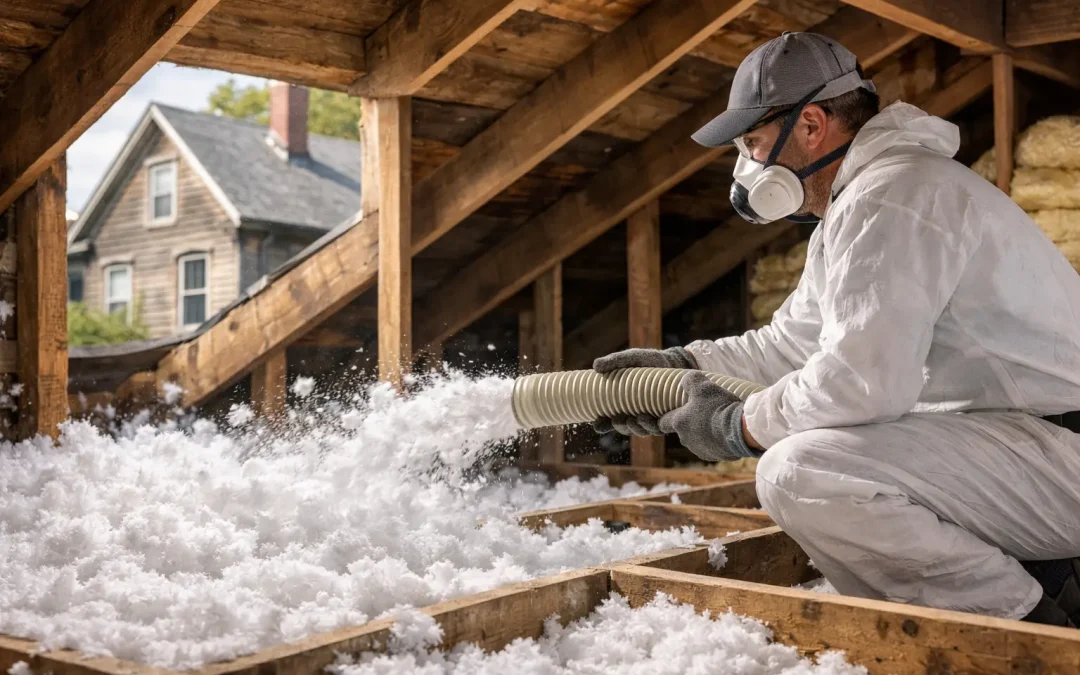
For a traditional vented attic with ductwork and living space below, air sealing followed by blown-in insulation at the attic floor is often a practical upgrade. Fiberglass blow-in can provide broad, even coverage over ceiling cavities and around many obstructions.
This approach can be cost-effective when the roof structure is sound, attic ventilation is functioning properly, and the home does not need a major change to the thermal boundary. It is particularly useful where existing insulation has settled or where thin, uneven coverage needs to be brought up to an appropriate depth.
The limitation is clear: blown-in fiberglass does not create a complete air barrier on its own. If large leaks remain at the ceiling plane, the home can still suffer from drafts, dust movement, and energy loss.
Spray foam at the attic floor
Spray foam can be used selectively or continuously at the attic floor to create a stronger air seal. Closed-cell foam delivers high R-value per inch and adds moisture resistance, while open-cell foam can provide excellent air sealing and sound control where its properties are appropriate.
This option is valuable when an older home has many penetrations, irregular framing, or difficult-to-reach leakage points. It can also be paired with other insulation types. For example, spray foam may seal critical areas first, followed by blown-in insulation to build the desired R-value across the attic floor.
That combined approach often provides strong performance without requiring foam across every surface of the attic.
Spray foam at the roof deck
When HVAC equipment and ducts are located in an unconditioned attic, insulating the roof deck may be worth serious consideration. Applying spray foam beneath the roof can bring the attic inside the home’s thermal envelope, reducing the extreme temperature swings that force attic ductwork to work harder.
In Payson and other high-country Arizona communities, that can improve comfort during both summer heat and winter cold. It may also reduce dust and outdoor pollutants entering through attic leakage.
Roof-deck foam changes the attic from a vented space to an unvented assembly, so it must be designed and installed correctly. Existing roof leaks, combustion appliances, ventilation details, and roof assembly conditions all matter. This is not a one-size-fits-all upgrade, but when it fits the home, it can provide a substantial performance improvement.
Do not ignore ducts, attic hatches, and ventilation
A well-insulated attic cannot fully compensate for leaky ducts. In older homes, duct connections may be loose, insulation around ducts may be damaged, and sections may run through extreme attic temperatures. Sealing and insulating ductwork is often one of the most direct ways to improve heating and cooling performance.
The attic hatch is another frequent weak point. A thin piece of plywood with no weatherstripping can become a major source of heat loss and air leakage. An insulated, gasketed hatch or access cover helps complete the air barrier.
Ventilation also deserves a measured approach. A vented attic needs clear soffit-to-ridge or soffit-to-gable airflow, with baffles that keep loose-fill insulation from blocking soffit vents. But ventilation should not be used as an excuse to leave major air leaks between the home and attic. The goal is a controlled attic system, not simply more outdoor air moving through the structure.
What homeowners should expect from a proper upgrade
A thoughtful attic insulation project should make a noticeable difference in how the home feels. Rooms below the attic may stay more stable throughout the day. Cold floors, hot ceilings, and persistent drafts can be reduced. HVAC equipment may run less often because the home is no longer losing as much conditioned air through the top of the building.
Energy savings depend on the home’s existing condition, local weather, thermostat habits, duct performance, and the scope of air sealing. No contractor should promise the same utility-bill reduction for every property. Still, homes with thin insulation and serious attic leakage often have substantial room for improvement.
The benefits go beyond utility costs. Better attic performance can help limit moisture-related problems, reduce airborne dust entering the home, and create a quieter, more comfortable indoor environment. For homeowners planning to stay in an older house for years, those daily comfort improvements can matter as much as the savings.
Get the details right before covering the attic
The best attic insulation projects are not rushed. They begin by identifying electrical, roof, moisture, duct, and air-sealing issues, then matching the insulation system to the home’s construction and performance goals. That process prevents expensive mistakes, such as burying a problem under fresh insulation or choosing a material that does not address the actual source of discomfort.
Ridgetopp Insulation helps homeowners evaluate attic conditions and select performance-focused solutions, including spray foam and conventional insulation systems where they make sense. A professional assessment can show whether your older home needs more insulation, better air sealing, a roofline approach, or a combination of all three.
A comfortable older home does not need to lose its character to perform better. Start at the attic, fix what is hidden, and give the rest of the house a stronger foundation for every season.