
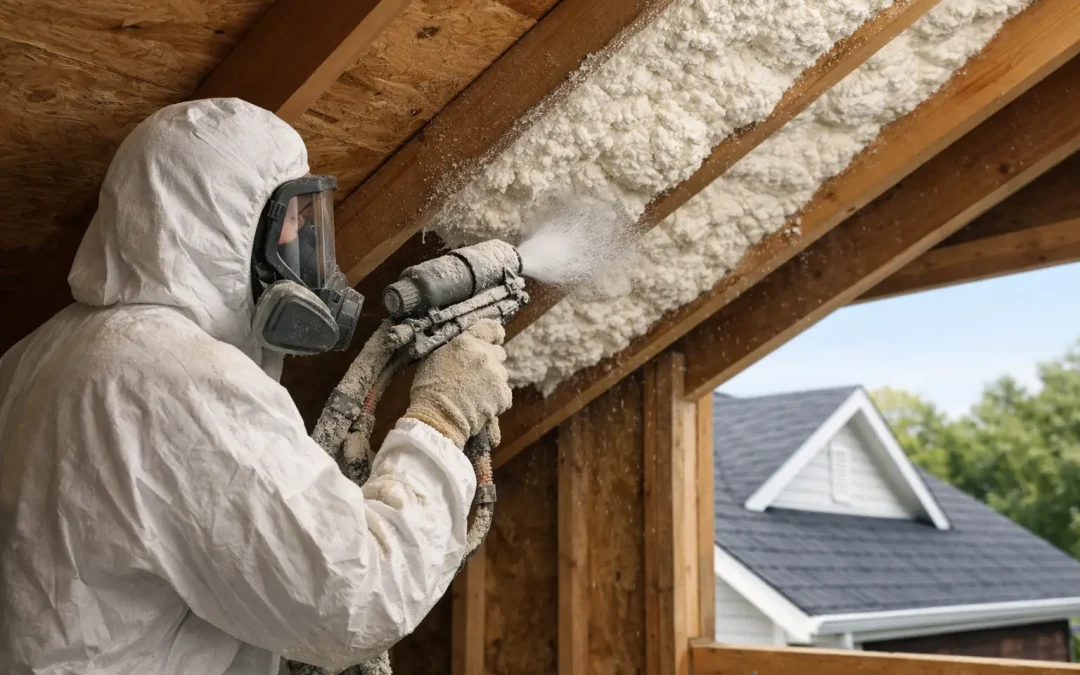
A roof can reach extreme temperatures under Arizona sun, and a conventional vented attic often allows that heat to build directly above the living space. A spray foam roof deck changes the equation by moving insulation from the attic floor to the underside of the roof sheathing. Done correctly, it creates a conditioned attic that is cooler, cleaner, and far less vulnerable to air leakage than a typical vented attic.
This approach is not simply about adding more insulation. It is a building-envelope decision that affects HVAC performance, moisture movement, ventilation strategy, and the long-term comfort of the home. For homeowners and builders who want better control over energy use and indoor conditions, it can be one of the most effective upgrades available.
What Is a Spray Foam Roof Deck?
A spray foam roof deck is insulation applied directly to the underside of roof sheathing, between and across the roof rafters. Rather than insulating the attic floor and venting the attic to the outdoors, the foam follows the roofline and brings the attic inside the home’s thermal boundary.
The result is an unvented attic assembly. Air-conditioning equipment, ductwork, and other mechanical components located in the attic now operate in a much more stable environment instead of baking in summer heat or facing cold nighttime temperatures in winter.
Spray foam earns its value because it does two jobs at once: it insulates and air seals. Fiberglass and blown-in products can deliver useful R-value, but they do not stop air movement on their own. Gaps around framing, penetrations, recessed fixtures, and transitions can allow conditioned air to escape and outdoor air to enter. Foam expands into those irregular areas, reducing the uncontrolled air leakage that drives drafts, dust, and high heating and cooling costs.
Why Insulating the Roofline Can Make a Major Difference
In a vented attic, the ceiling insulation separates the house from an attic that may be dramatically hotter than the outdoors. Any duct leaks, poorly sealed ceiling penetrations, or gaps in insulation become more costly because they are exposed to that intense attic temperature.
Insulating the roof deck moves that thermal barrier upward. The attic temperature becomes much closer to the temperature inside the home, which can reduce the workload on cooling equipment and protect duct performance. This is especially valuable in homes with HVAC systems or extensive ductwork located overhead.
A properly designed roofline system can also improve comfort in rooms below the attic. Bedrooms with uneven temperatures, persistent ceiling heat, or noticeable drafts often point to weaknesses in the home’s upper building envelope. Spray foam addresses those weak points at their source instead of asking the HVAC system to compensate for them.
For Arizona homes, the benefit is not limited to summer. Payson and Rim Country properties can see warm days, cool nights, and meaningful winter heating demand. A tight, well-insulated roof assembly helps the home respond more predictably across those swings.
Open-Cell vs. Closed-Cell Foam at the Roof Deck
Both open-cell and closed-cell spray foam can be used at a roof deck, but they do not serve the same purpose. The right choice depends on roof design, required R-value, available rafter depth, moisture conditions, and local code requirements.
Open-Cell Spray Foam
Open-cell foam is lighter and expands significantly during installation. It fills complex cavities exceptionally well and provides strong air-sealing performance. Because it is vapor permeable, it allows the roof sheathing to dry more readily toward the interior if moisture ever reaches the assembly.
Open-cell foam is often a practical choice where deeper rafter cavities are available and the primary goal is air sealing, comfort, and thermal performance. It can also help reduce outdoor noise, which is useful for homes near traffic, busy neighborhoods, or exposed areas.
Its trade-off is that it provides less R-value per inch than closed-cell foam and does not function as a vapor retarder. In some roof assemblies, additional design measures may be necessary to manage vapor and meet performance targets.
Closed-Cell Spray Foam
Closed-cell foam is denser, delivers a higher R-value per inch, and adds significant moisture resistance. It is often the stronger option when rafter depth is limited or a project needs more insulation value in a thinner layer. Its rigid structure can also add strength to the assembly.
For metal buildings, low-slope roof areas, or projects where condensation control is a major concern, closed-cell foam is frequently the better fit. It creates a highly effective air barrier and resists water vapor movement far more than open-cell foam.
The trade-off is cost. Closed-cell foam is a premium material, and using it everywhere is not automatically the best value. An experienced insulation contractor will look at the full roof assembly, not just the highest R-value on a product label.
A Spray Foam Roof Deck Must Be Designed as an Unvented Assembly
This is where quality installation matters most. Once foam is applied to the underside of the roof deck, the attic should not continue operating as a conventionally vented space. Ridge vents, soffit vents, gable vents, and other openings may need to be addressed as part of the design.
Leaving major attic ventilation paths open can undermine the purpose of the system. Outdoor air can still enter the space, carrying heat, dust, humidity, and wind-driven pollutants. The attic should become part of the conditioned building enclosure, not a partially vented space with foam installed around it.
Roofing details matter, too. The roof covering must be in good condition before foam is installed. Spray foam is not a repair for damaged shingles, failed flashing, or an active roof leak. If water enters from above, it needs to be corrected at the roof exterior.
The home also needs proper mechanical ventilation. A tighter home has many advantages, but indoor air quality must be considered deliberately. Kitchen exhaust, bath ventilation, combustion safety, and fresh-air strategies should be evaluated when the building envelope is substantially tightened.
Common Questions Homeowners Should Ask Before Installation
The most useful question is not, “How much foam can we add?” It is, “What will this roof assembly need to perform well for decades?” A qualified contractor should be prepared to evaluate the roof condition, attic layout, duct location, existing ventilation, framing depth, and insulation target before recommending a system.
Homeowners should also ask how attic access will be handled, whether ignition or thermal barriers are required, and how recessed lights, chimneys, flues, and other heat-producing components will be protected. Foam must never be installed where required clearances are ignored.
If the home has gas appliances, fireplaces, or atmospheric-combustion equipment, combustion air and venting deserve particular attention. Air sealing improves efficiency, but it cannot come at the expense of safe appliance operation.
For builders, the timing of installation matters. Spraying after mechanical rough-in allows the foam to seal around penetrations and duct transitions, but the crew must still have clear access to the roof deck and framing. Good coordination prevents missed areas and costly rework.
What Results Should You Expect?
A well-installed spray foam roof deck can deliver lower cooling and heating loads, more even room temperatures, reduced drafts, and a cleaner attic environment. Many homeowners also notice that rooms below the attic are less affected by afternoon heat and that their HVAC systems run more consistently rather than cycling hard to catch up.
Savings vary by home. Duct leakage, existing insulation quality, roof geometry, window performance, thermostat settings, and HVAC condition all affect the result. Spray foam should be viewed as a long-term performance upgrade, not a promise of one fixed utility-bill percentage.
The biggest value often comes from what occupants feel every day: fewer hot and cold spots, less dust entering through ceiling gaps, quieter indoor spaces, and better control over the environment they pay to heat and cool.
Choose Installation Quality Over the Lowest Bid
Spray foam is only as good as the installation. The material must be mixed at the proper ratio, applied at the correct thickness, and installed on clean, dry surfaces. Poor application can lead to uneven coverage, adhesion problems, odor concerns, or areas that fail to achieve the intended performance.
Ridgetopp Insulation evaluates the complete insulation strategy, including the conditions around the roof deck, rather than treating foam as a one-size-fits-all product. That approach protects the investment and helps ensure the attic, roof, and HVAC system work together.
If your attic feels like a furnace, your upstairs rooms never seem to stabilize, or your ductwork is trapped in extreme temperatures, a roofline insulation assessment is a practical next step. The right spray foam design can turn one of the home’s biggest energy liabilities into a controlled, high-performing part of the building.