
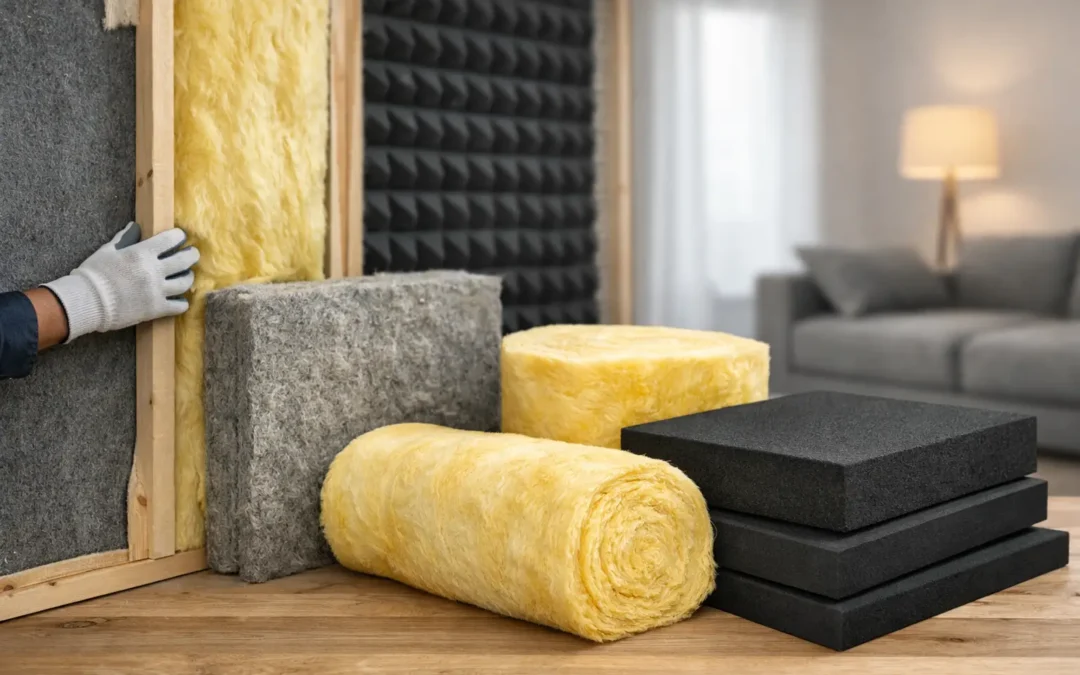
That room that always sounds louder than it should usually has a building-envelope problem, not just a noise problem. The right insulation for noise reduction can make a bedroom quieter, a home office more usable, and a commercial space less distracting – but only if the material matches the kind of sound you are trying to control.
A lot of property owners assume all insulation helps with sound in the same way. It does not. Some products are better at absorbing airborne noise like voices, TVs, and barking dogs. Others help more with air sealing, which matters when sound is slipping through gaps around framing, outlets, attic bypasses, or wall penetrations. If you want real results, you have to look at the whole assembly, not just the insulation label.
How insulation for noise reduction actually works
Sound moves through buildings in two main ways. Airborne noise travels through the air – conversation, music, traffic, or mechanical equipment. Impact noise comes from vibration – footsteps on an upper floor, a door slamming, or movement across a framed structure.
Insulation helps most with airborne sound. It works by reducing the amount of sound energy that passes through wall cavities, floor systems, and ceilings. But there is a catch: cavity insulation alone is rarely the whole answer. If air can leak through cracks, recessed lights, duct openings, or poorly sealed framing joints, sound can leak too.
That is why the best-performing assemblies combine insulation with air sealing. In practical terms, that means a wall or roof system is quieter when it is both insulated well and sealed tightly. This is one reason spray foam gets attention in high-performance construction. It insulates and air seals in one step, which helps cut down on the pathways noise uses to enter a building.
Which insulation is best for noise reduction?
The honest answer is that it depends on where the noise is coming from and what you are trying to improve. There is no universal best product for every situation, but there are clear strengths and trade-offs.
Spray foam and sound control
Spray foam is often chosen first for energy efficiency, draft reduction, and moisture control, but it can also improve sound performance. Open-cell spray foam is especially useful for interior sound control because its softer, less rigid structure helps absorb airborne noise within wall and ceiling cavities. It does a strong job of reducing sound transfer while also sealing gaps that let noise move from one space to another.
Closed-cell spray foam is denser and brings higher R-value per inch, along with added rigidity and moisture resistance. It is excellent when the project also needs structural reinforcement or tighter control over air and vapor movement. For pure interior sound absorption, though, open-cell is often the better fit. Denser does not automatically mean quieter in every assembly.
This is where contractor guidance matters. If your main goal is to quiet a shared interior wall, one recommendation may make sense. If your concern is road noise entering through exterior walls and attic transitions, the right solution may look different because air leakage becomes a bigger part of the problem.
Fiberglass batt insulation
Fiberglass batt insulation is common, affordable, and can help with sound control when installed correctly. It absorbs some airborne sound in wall and floor cavities, which makes it a reasonable option for interior partitions and between floors.
The problem is consistency. Fiberglass only performs as well as the installation. Gaps, compression, and misalignment around wiring or plumbing reduce both thermal and acoustic value. It also does not air seal, so if the assembly has leaks, outside noise can still find an easy path indoors. For budget-conscious projects, fiberglass can improve noise levels, but it usually does not deliver the same overall envelope performance as spray foam.
Rockwool batt insulation
Rockwool is one of the stronger choices for absorbing sound in framed walls and ceilings. It is denser than fiberglass, fits snugly, and holds its shape well. That makes it a popular material for media rooms, bedrooms, multifamily walls, and offices where sound privacy matters.
It also brings fire resistance and moisture tolerance, which adds value beyond acoustics. The trade-off is cost. Rockwool usually costs more than fiberglass, and like fiberglass, it does not create an air seal on its own. In many projects, it performs very well for interior sound control, but if the real issue is exterior noise entering through leaks and bypasses, rockwool by itself may not solve the whole problem.
Why air sealing matters as much as insulation
If you can feel drafts, you can expect sound leakage too. That connection is often overlooked. A home with leaky attic penetrations, rim joists, wall gaps, and recessed fixtures may never get much quieter no matter how much conventional insulation is added.
This is where spray foam stands apart. Because it expands to fill cracks and irregular spaces, it reduces the air movement that carries sound. That does not mean spray foam makes a building soundproof. Soundproofing is a much higher bar and usually requires layered assemblies, decoupling methods, and specialty products. But for day-to-day noise reduction, especially from outdoors or from adjacent spaces, air sealing changes the result in a noticeable way.
In Arizona homes, that matters for more than comfort. Many property owners are already looking for better insulation because rooms run hot, HVAC costs are climbing, or dust and drafts are constant. When insulation upgrades address those problems and cut down on noise at the same time, the investment does more work.
Best places to add insulation for noise reduction
Not every part of the building has the same impact. Some upgrades pay off faster than others.
Exterior walls can help reduce traffic noise, neighborhood noise, and general outdoor sound, especially when the assembly also gets better air sealing. Interior walls around bedrooms, bathrooms, laundry rooms, and home offices are another smart target because that is where privacy complaints often start.
Ceilings and floor systems matter when sound is moving between levels. If footsteps, voices, or TV noise carry from floor to floor, adding insulation between joists can make a meaningful difference. Attics can also play a role, particularly if noise is entering from roofline gaps, vent pathways, or duct penetrations.
Metal buildings deserve special mention. They can be noisy by nature because of their large open interiors and the way metal surfaces reflect sound. In those applications, insulation selection is doing double duty – controlling temperature swings while reducing echo and sound intrusion. A poorly insulated metal building is rarely comfortable acoustically or thermally.
When insulation alone is not enough
Some noise problems go beyond what insulation can fix by itself. If you are dealing with heavy impact noise, low-frequency bass, or severe exterior sound, the assembly may need more than cavity fill.
Drywall layers, resilient channels, acoustic sealants, underlayments, better windows, and solid-core doors all affect the outcome. This is why one homeowner may see a big improvement from insulation alone while another needs a more complete plan. The right expectation is improvement, not magic.
That said, insulation is often the foundation of a better system. If the walls, attic, or crawl space are under-insulated and leaky, starting there makes sense. It improves comfort, efficiency, and noise control at the same time, rather than solving only one issue while leaving the others behind.
What to look for before choosing a product
The best decision usually comes down to three questions: where is the noise coming from, what else do you want the insulation to do, and how long do you plan to own the property?
If the goal is the strongest overall building performance – lower energy bills, fewer drafts, better moisture control, and quieter interiors – spray foam often offers the most complete value. If the project is focused mainly on interior sound absorption at a lower upfront price, fiberglass or rockwool may fit. For some buildings, the smartest approach is a combination, using different materials in different assemblies based on function.
That is the contractor mindset: choose insulation based on performance, not habit. A cheap product installed in the wrong place is still the wrong solution.
If you are serious about a quieter home or building, treat noise as part of the whole comfort picture. The spaces that feel best tend to be the ones that are sealed well, insulated well, and built with the full envelope in mind.