
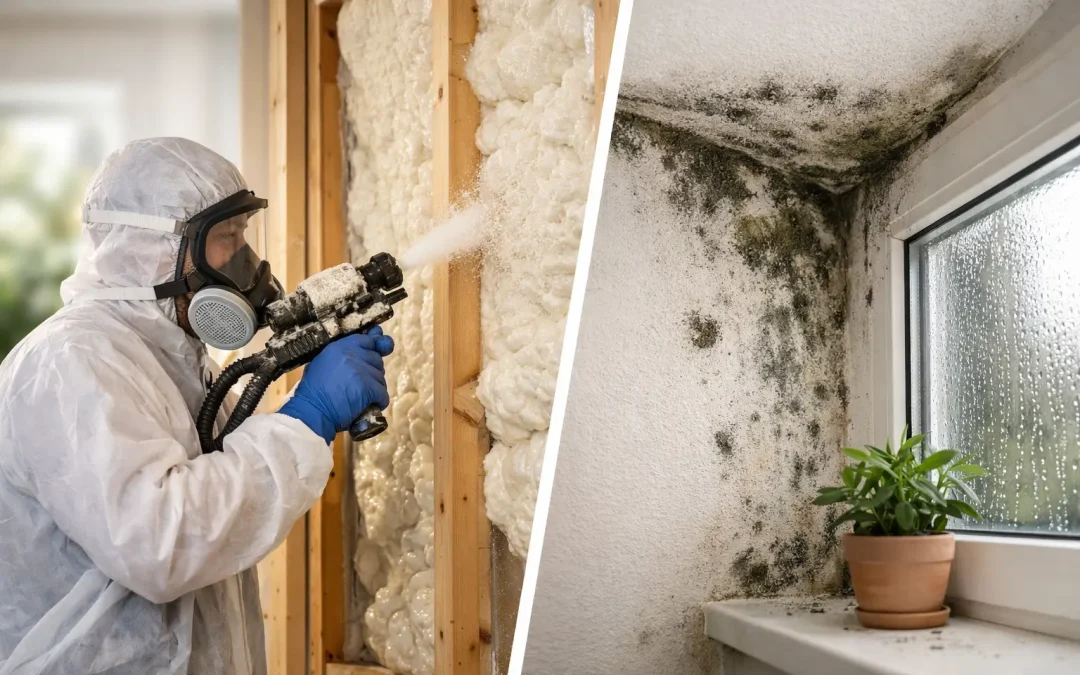
A musty smell in an attic, crawl space, or exterior wall is rarely just an insulation problem. It is a moisture problem first. So, can spray foam prevent mold? When it is correctly selected and professionally installed as part of a sound building envelope, spray foam can dramatically reduce the conditions mold needs to grow: humid air, condensation, and hidden moisture.
That does not mean spray foam is a cure for an active leak or existing mold contamination. It means the right spray foam system can help keep warm, moisture-laden air from reaching cold surfaces where condensation forms. For homeowners and builders, that protection can support a drier, healthier, more durable building.
Can Spray Foam Prevent Mold?
Spray foam does not kill mold, and it should never be installed over active mold growth or wet building materials. Mold must be removed, the moisture source must be corrected, and the affected area must be thoroughly dry before insulation work begins.
Once those issues are addressed, spray foam can help prevent future mold by reducing air leakage and managing moisture movement. Unlike conventional insulation that can slow heat transfer while still allowing air to move around it, spray foam expands into cracks, joints, and irregular cavities. That air seal matters because moving air carries moisture.
When humid indoor or outdoor air leaks into a wall, attic, or crawl space and touches a cooler surface, water vapor can condense. Repeated condensation can dampen wood framing, roof decking, drywall, and other organic materials. Those materials become potential food sources for mold. Reducing uncontrolled airflow lowers that risk.
Why Air Sealing Matters More Than R-Value Alone
Many insulation decisions start and end with R-value. R-value is important because it measures resistance to heat flow, but it does not tell the full moisture story. A high-R-value material with air gaps can still allow humid air to reach cold surfaces behind the insulation.
Spray foam insulates and air seals in one application. That creates a more continuous thermal boundary and reduces the drafts that make rooms uncomfortable and energy bills higher. It also limits the hidden pathways that can carry moisture into wall and roof assemblies.
In Arizona, moisture concerns can be easy to underestimate. Dry outdoor conditions are common, but monsoon weather, plumbing leaks, poorly vented bathrooms, evaporative cooling equipment, and large temperature swings can all create localized moisture problems. Mountain communities around Payson can also experience cold nights and seasonal conditions that make condensation control especially relevant.
A tighter building envelope is not just about comfort. It is part of a long-term strategy for protecting framing, sheathing, and indoor air quality.
Closed-Cell vs. Open-Cell Spray Foam for Moisture Control
Both types of spray foam provide strong air-sealing performance, but they handle moisture differently. The correct choice depends on the assembly, climate exposure, and project goals.
Closed-cell spray foam
Closed-cell spray foam is dense, rigid, and highly resistant to moisture. It adds substantial R-value per inch and can function as a vapor retarder when applied at the appropriate thickness. It is often an excellent option for areas where moisture exposure is a bigger concern, such as crawl spaces, metal buildings, rim joists, foundation-related applications, and certain roof or wall assemblies.
Because it resists water absorption, closed-cell foam can provide an added layer of protection when conditions are demanding. It can also strengthen certain assemblies due to its rigid structure. However, it costs more than open-cell foam and should be specified for the job rather than chosen simply because it is denser.
Open-cell spray foam
Open-cell spray foam is lighter, expands significantly, and is effective at air sealing. It is commonly used in wall cavities and unvented attic assemblies where its expansion helps fill irregular spaces. It can improve comfort, reduce outside noise, and limit the airflow that contributes to condensation.
Open-cell foam is more vapor-permeable than closed-cell foam. That is not automatically a drawback. In the right assembly, vapor permeability can allow materials to dry. But it also means open-cell foam is not the same moisture barrier as closed-cell foam. The roof design, local conditions, and whether the area needs inward or outward drying all matter.
The best answer is not that one type always prevents mold better. The best answer is that the insulation system must be designed for the specific building and moisture conditions.
What Spray Foam Cannot Fix
Spray foam is a high-performance insulation solution, not a substitute for repair work. Installing foam without identifying moisture sources can trap a problem inside an assembly or conceal damage until it becomes more expensive.
Before any foam is installed, a qualified contractor should look for roof leaks, flashing failures, plumbing leaks, foundation moisture, damaged siding, wet framing, and condensation from HVAC ducts or bathroom ventilation. In attics, roof decking should be dry and structurally sound. In crawl spaces, standing water, drainage problems, and exposed soil moisture need to be addressed first.
Indoor humidity also matters. A well-air-sealed home needs intentional ventilation and properly sized heating and cooling equipment. If a home has consistently high humidity from daily activities, an oversized air conditioner, or an unvented bath fan, insulation alone will not solve the issue. The goal is controlled airflow, not a house that cannot breathe.
Installation Quality Determines the Result
Even premium spray foam can underperform if the installation is rushed or poorly planned. Gaps around framing transitions, thin application areas, missed penetrations, or improper substrate conditions can compromise air sealing and moisture control.
Professional installation begins with preparation. Surfaces must be clean and dry, and the installer must account for the intended thickness, access conditions, and building assembly. The foam must be applied evenly and allowed to cure correctly. In some projects, additional ignition-barrier, vapor-control, or ventilation details may be required.
This is especially important in attics. Converting a vented attic into an insulated roofline changes how the space manages heat and moisture. HVAC equipment and ductwork may benefit from being brought inside the conditioned envelope, but the attic design must be evaluated as a complete system. Simply spraying foam without addressing ventilation details, roof condition, and mechanical needs is not a performance upgrade.
Signs Mold Risk May Be a Building-Envelope Issue
Some mold problems are obvious, but others start behind finished surfaces. Watch for recurring musty odors, discolored drywall, peeling paint, condensation on windows, damp insulation, warped trim, or rooms that feel unusually cold, hot, or humid.
High utility bills can also point to air leakage. If outdoor air is freely entering through attic bypasses, wall penetrations, or crawl space gaps, it can bring moisture along with it. Drafty rooms, uneven temperatures, and persistent humidity are often connected symptoms rather than separate problems.
A careful insulation assessment can identify where the building envelope is failing. The right solution may include spray foam, but it may also require repairs, ventilation improvements, drainage corrections, or a combination of measures.
A Better Approach to Mold Prevention
Lasting mold prevention starts with controlling bulk water, air movement, humidity, and surface temperatures. Spray foam is valuable because it addresses two major parts of that equation at once: insulation and air sealing.
For a dry, well-maintained structure, properly installed spray foam can reduce the chance that moisture reaches vulnerable cold surfaces. It can improve comfort, help lower heating and cooling costs, and create a more stable indoor environment. Closed-cell foam can add stronger moisture resistance where the assembly calls for it, while open-cell foam can provide effective air sealing in the right applications.
If you are dealing with a musty attic, a damp crawl space, or rooms that never seem comfortable, start by finding the moisture source instead of covering the symptom. A professional evaluation can determine whether spray foam is the right part of the fix and help protect your home from the conditions mold depends on.