Your attic can be brutally hot while the rooms below it struggle to stay cool. In winter, that same space can pull valuable heat out of your living area. Understanding how attic insulation works explains why a properly insulated, air-sealed attic is one of the most effective ways to improve comfort, control energy costs, and reduce strain on your HVAC system.
Insulation is not simply a layer of material placed above the ceiling. It is part of your home’s thermal boundary – the system that separates conditioned indoor air from Arizona’s outdoor temperatures. The right material, installed in the right location, helps your home hold onto the temperature you pay to create.
How attic insulation works against heat flow
Heat naturally moves from a warmer area to a cooler one. During a hot Arizona afternoon, heat from the sun warms the roof, attic framing, and air inside the attic. Without enough insulation at the ceiling level or roofline, that heat transfers into the rooms below. Your air conditioner must then run longer to maintain the thermostat setting.
In cold weather, the direction reverses. Heated indoor air moves toward the cooler attic and roof. Insulation slows that transfer, keeping more of your furnace’s heat in the living space.
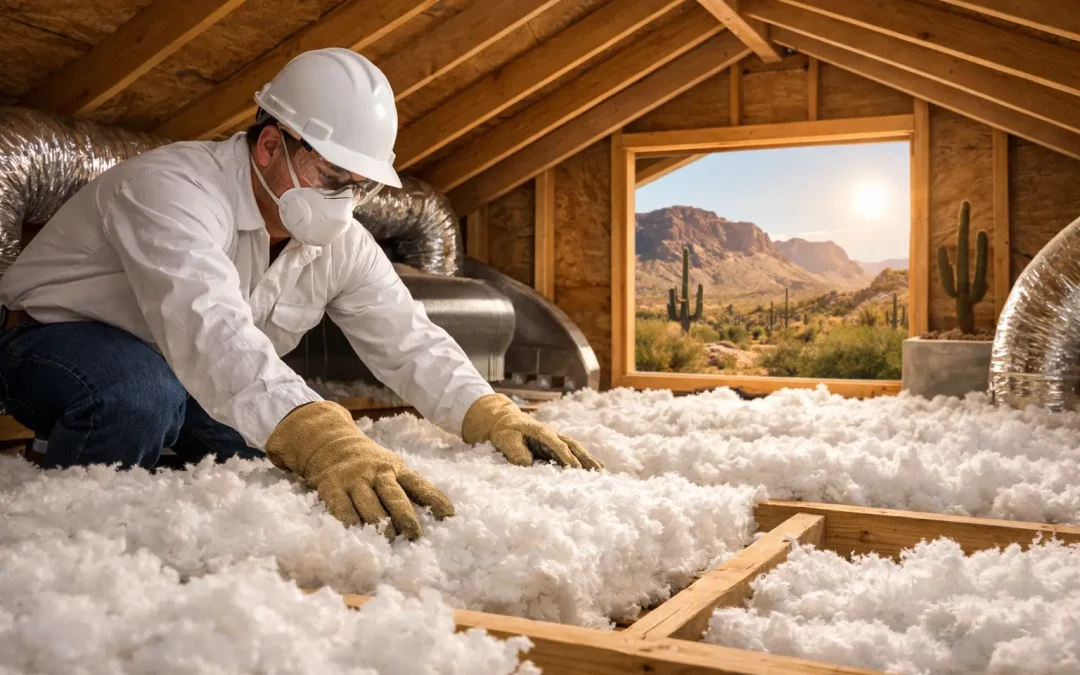
Most conventional attic insulation works by trapping countless small pockets of air. Fiberglass and rockwool fibers create resistance to conductive heat flow, while blown-in fiberglass fills across the attic floor to form a continuous thermal layer. The effectiveness of that resistance is measured by R-value. A higher R-value means greater resistance to heat moving through the material.
R-value matters, but it is not the whole story. An attic can have a respectable amount of insulation and still underperform if outside air is leaking through gaps around wiring, recessed lights, plumbing penetrations, duct chases, and the attic hatch. Moving air can carry heat and moisture far more effectively than insulation alone can stop it.
Insulation and air sealing solve different problems
Think of insulation as a winter coat and air sealing as fastening the zipper. A thick coat with an open zipper still lets cold air in. In the same way, fiberglass batts or loose-fill insulation can slow heat flow but do not automatically create an air barrier.
This distinction is a major reason spray foam is often a premium attic solution. Open-cell and closed-cell spray foam expand into cracks, seams, and irregular cavities, insulating and air sealing in one application. When applied correctly, foam reduces the uncontrolled air movement that causes drafts, hot and cold rooms, dust infiltration, and unnecessary energy use.
The best approach depends on the attic design and the home’s goals. In a traditional vented attic, air sealing the ceiling plane and adding insulation across the attic floor can be an effective solution. In an unvented or conditioned attic, spray foam may be applied to the underside of the roof deck, bringing the attic within the home’s conditioned envelope.
That second approach can be especially valuable when HVAC equipment or ductwork runs through the attic. Instead of forcing cooled air through ducts surrounded by extreme attic heat, the equipment operates in a more stable environment. The result can be better system performance and more consistent comfort.
Why the location of insulation matters
Where insulation goes changes how the entire attic behaves. There are two common strategies, and neither should be selected by habit alone.
Insulating the attic floor
With an attic-floor approach, insulation sits above the ceilings of the rooms below. The attic remains vented and outside the conditioned part of the home. This is often a practical option when the attic is used only for limited storage and mechanical equipment is not located there.
Before adding material, the ceiling plane should be properly air sealed. Otherwise, warm or cool indoor air can bypass the insulation through openings in the framing. Blown-in fiberglass is often well suited for this application because it can cover broad attic areas and fill around framing more consistently than poorly fitted batts.
The trade-off is that the attic itself will still experience outdoor temperature extremes. Any ducts, air handlers, or plumbing located there need careful attention.
Insulating the roofline
With a roofline approach, insulation is installed along the underside of the roof deck and sometimes the attic walls. This creates a conditioned or semi-conditioned attic space. Spray foam is commonly used because it adheres to the roof deck and provides air-sealing performance that fibrous materials do not provide on their own.
A roofline system can make sense for homes with attic HVAC systems, complicated roof framing, or a goal of stronger air and moisture control. Closed-cell foam provides a higher R-value per inch and offers substantial moisture resistance. Open-cell foam expands significantly, works well in many roof assemblies, and can be a cost-effective choice where its lower R-value per inch fits the design.
The right choice requires an evaluation of the roof assembly, ventilation plan, climate conditions, mechanical systems, and local code requirements. More insulation is not automatically better if it is installed in the wrong place or creates a moisture-management problem.
Moisture control is part of attic performance
Moisture problems in attics are often blamed on insulation, but the real issue is usually uncontrolled air movement, roof leaks, poor ventilation, or an improperly designed assembly. Humid indoor air that reaches a cool surface can condense. Over time, that moisture may contribute to mold, wood damage, odors, and reduced insulation performance.
Arizona is known for dry conditions, but mountain communities and Rim Country homes still face seasonal temperature swings, monsoon moisture, and cold winter nights. A building envelope needs to manage both heat and moisture. Air sealing reduces the pathways that carry humid indoor air into hidden attic cavities, while the right insulation system helps keep interior surfaces at safer temperatures.
Closed-cell spray foam can be particularly useful where moisture resistance and high R-value in a limited space are priorities. Still, foam is not a substitute for repairing roof leaks or addressing bulk water intrusion. A dry, sound roof assembly comes first.
What reduces real-world attic insulation performance
Even quality insulation can fall short when installation details are missed. Compression reduces the performance of fiberglass batts because it removes the air spaces that provide resistance. Gaps, voids, and thin spots create easy routes for heat to move. Wind washing near vented attic edges can also disrupt loose-fill insulation if baffles and blocking are not installed correctly.
Duct leakage is another common problem. Leaky ducts in a hot attic waste conditioned air before it reaches the rooms that need it. Insulating the attic helps, but it does not correct damaged, disconnected, or poorly sealed ductwork. A whole-home perspective produces better results than treating insulation as an isolated product.
Attic access doors deserve attention as well. A poorly sealed, uninsulated hatch can act like a hole in an otherwise well-performing ceiling. Recessed fixtures, exhaust fans, and plumbing penetrations should be evaluated carefully so air sealing does not interfere with safety clearances or ventilation requirements.
Signs your attic may need attention
Uneven room temperatures, persistent drafts, high heating or cooling bills, and HVAC systems that run constantly are all common warning signs. Upstairs rooms that become uncomfortable in the afternoon, dusty indoor air, or visible insulation that is thin, uneven, or disturbed can point to attic performance issues.
A professional assessment should look beyond the depth of the insulation. The useful questions are where the home’s air boundary is, whether it is continuous, how ducts and mechanical equipment are located, and whether moisture or ventilation concerns are present. That is how a contractor can recommend a system that fits the building rather than selling a one-size-fits-all material.
For homeowners and builders, attic insulation is an investment in the entire building envelope. When the thermal layer, air barrier, moisture strategy, and HVAC system work together, the payoff is felt every day: steadier temperatures, fewer drafts, cleaner indoor air, and a home that wastes less energy. A careful attic evaluation is the right place to start when comfort has become harder to maintain.