
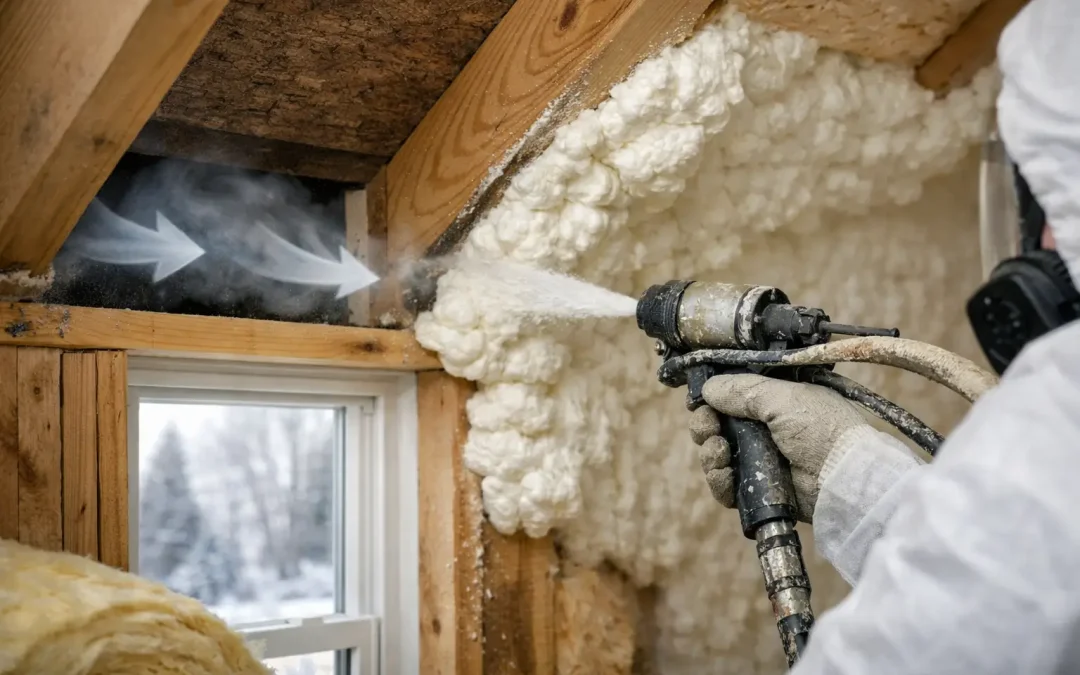
You feel drafts long before you see the problem. A room stays cold even when the heat is running. One wall always feels hotter in the afternoon. Your floors are chilly, your energy bills keep climbing, and certain parts of the house never seem comfortable. That is exactly how spray foam stops drafts – by sealing the hidden gaps that let outside air move through your home.
Most draft problems are not caused by a lack of insulation alone. They come from air leakage. Traditional insulation can slow heat transfer, but many materials do very little to stop moving air. Spray foam is different because it expands into cracks, joints, and irregular spaces, creating an air seal and insulation layer at the same time. That combination is what makes it such a strong solution for homes and buildings that struggle with comfort and efficiency.
Why drafts happen in the first place
A draft is uncontrolled air movement. Outside air finds its way into the building envelope, and conditioned indoor air escapes through the same weak points. This often happens around rim joists, attic penetrations, wall cavities, crawl spaces, recessed lighting, plumbing and electrical openings, and connections between framing materials.
In Arizona, draft issues can work both ways depending on the season and elevation. During colder months, warm indoor air leaks out and colder outdoor air pulls in. During hotter stretches, the opposite pressure difference can bring in unwanted heat. In both cases, your HVAC system has to work harder to keep up.
What many property owners miss is that fiberglass batts and blown insulation do not automatically stop this airflow. If air can move around or through the insulation, you can still end up with drafts, uneven temperatures, and wasted energy.
How spray foam stops drafts at the source
Spray foam works because it does more than fill space. It adheres directly to the surface where it is applied and expands to close off the tiny openings that air uses to travel through a structure. Once cured, it forms a continuous barrier that reduces uncontrolled air movement.
That matters because stopping drafts is really about controlling the building envelope. If you only add insulation without addressing leakage, you may improve R-value on paper while still feeling the same comfort problems in real life. Spray foam tackles both issues in one installation.
It seals irregular gaps that other materials miss
Homes are full of small penetrations and framing transitions. These are the trouble spots where drafts often begin. Spray foam can conform to uneven surfaces and hard-to-reach cavities, which makes it effective in places where batt insulation leaves voids or where cut-fit installation is difficult.
This is especially valuable in attics, crawl spaces, and wall assemblies with lots of wiring, plumbing, or mechanical penetrations. Air does not need a large opening to create a noticeable draft. Even minor gaps can add up across an entire home.
It reduces air exchange between indoors and outdoors
When spray foam creates a tighter seal, less outside air enters through random leaks. That means fewer cold spots in winter, less heat intrusion in summer, and more stable indoor temperatures overall. Occupants usually notice this as a comfort improvement first, often before they notice utility savings.
A tighter envelope can also help reduce dust, pollen, and outdoor pollutants that enter through leaks. For homeowners who want a healthier indoor environment, that added air control can be a major benefit.
Open-cell vs. closed-cell for draft control
Both open-cell and closed-cell spray foam can help stop drafts, but they are not identical products. The right choice depends on the application, the building assembly, and the performance goals.
Open-cell foam is lighter and expands significantly, which helps it fill cavities and seal gaps well. It is often used in interior wall and roofline applications where air sealing and sound control are priorities. Closed-cell foam is denser, has a higher R-value per inch, and adds more moisture resistance. It is often the stronger choice where space is limited or where extra rigidity and vapor control matter.
For draft reduction alone, either can be effective when installed correctly. The better option depends on where the foam is going and what else the assembly needs to do. In a vented attic floor, one approach may make sense. In an unvented roof deck, crawl space, metal building, or exterior wall, another may be more appropriate.
Where spray foam makes the biggest difference
Not every draft comes from the same place. Some homes leak most at the attic level. Others have major losses through rim joists, floors, attached garages, or wall penetrations. The value of spray foam increases when it is applied where air leakage is most severe.
Attics are one of the biggest problem areas because warm air naturally rises and escapes through ceiling penetrations, top plates, and duct openings. Sealing the attic boundary can dramatically improve comfort throughout the house.
Crawl spaces and rim joists are another common source. If outside air is moving under the floor system, occupants often feel it as cold floors or uneven room temperatures. Spray foam can create a much tighter boundary in these locations than conventional insulation alone.
In commercial and metal buildings, spray foam is often chosen because it handles both insulation and air sealing in a single system. Large open structures can be especially vulnerable to air leakage, and stopping that movement is critical for temperature control and efficiency.
What spray foam changes beyond comfort
Most people start by asking about drafts, but the performance benefits do not stop there. Once uncontrolled air movement is reduced, the entire building tends to work better.
HVAC equipment may run less often because conditioned air is staying where it belongs. Rooms stay closer to the thermostat setting. Indoor humidity is easier to manage because outside air is not constantly entering through gaps. That can help lower the risk of condensation problems in certain assemblies.
Closed-cell foam can add another layer of protection in areas where moisture resistance matters. That does not mean spray foam solves every water issue. Roof leaks, drainage problems, and bulk water intrusion still need to be addressed directly. But controlling air movement can reduce one major path for moisture migration.
Why installation quality matters
Spray foam is a premium insulation product, but it only performs like one when it is installed properly. Thickness, coverage, substrate conditions, and application technique all affect results. A sloppy installation can leave voids, miss key leakage areas, or create uneven performance.
That is why experience matters. A trained spray foam contractor understands where drafts actually originate, how different assemblies behave, and which foam type is best for the job. Good installers also look at the whole system, not just the square footage being sprayed.
This is one reason many homeowners and builders in mountain and desert climates look for specialists rather than general insulation crews. In places like Payson and the surrounding region, temperature swings can put real stress on a building envelope. Air sealing is not a cosmetic upgrade. It is a performance decision.
Is spray foam always the right answer?
Not always everywhere. Some projects only need targeted air sealing in a few specific locations. In other homes, a hybrid approach makes sense, using spray foam at major leakage points and another insulation type in less critical areas.
Budget is part of the conversation too. Spray foam costs more upfront than fiberglass or blown-in products. But if the goal is to stop drafts, improve comfort, and get stronger long-term efficiency, it often delivers value that lower-cost materials cannot match on their own.
The key is to think beyond insulation thickness and focus on building performance. If your home still feels drafty, the missing piece is often not more insulation. It is better air control.
When that is the real problem, spray foam stands out because it addresses the cause instead of masking the symptoms. A home that feels consistent, quieter, and easier to heat and cool is usually not an accident. It is the result of a tighter, better-sealed envelope that works the way it should.