
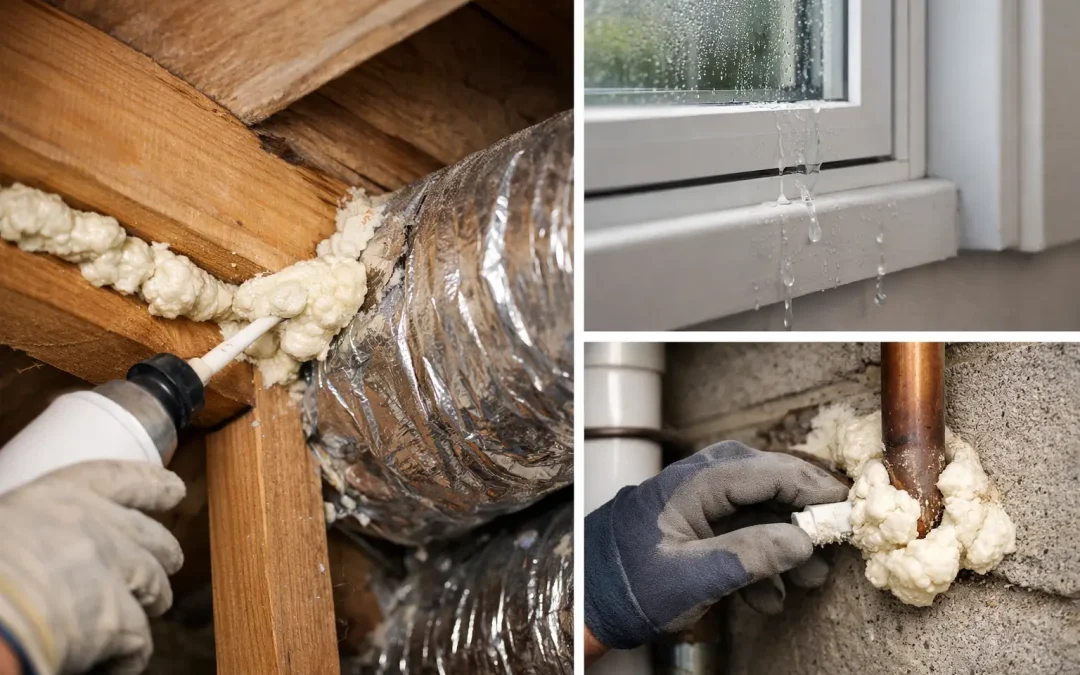
A room that feels cold near the floor in winter or overheated by midafternoon in summer usually has more than an insulation problem. It has an air leakage problem. Understanding how spray foam seals leaks explains why it can make such a dramatic difference in comfort, energy use, and indoor air quality.
Traditional insulation can slow heat transfer, but many types do not stop moving air. Air still slips around wiring holes, plumbing penetrations, attic framing, exterior wall seams, and the small gaps left where different building materials meet. Spray foam addresses both jobs at once: it insulates the building envelope while creating an air barrier where it is applied.
How Spray Foam Seals Leaks at the Source
Spray foam insulation begins as two liquid components that are mixed at the application gun. Once sprayed, the material expands quickly and adheres to the surrounding surface. That expansion is what allows foam to fill irregular spaces that are difficult to seal with batts, loose-fill insulation, or rigid panels alone.
Instead of simply resting between framing members, properly installed spray foam conforms to the cavity. It wraps around pipes, electrical boxes, roof-deck framing, and other obstructions. As the foam cures, it becomes a continuous layer that blocks the pathways air uses to enter or escape a building.
This matters because air leaks are rarely limited to one large opening. Most homes lose conditioned air through dozens or hundreds of small gaps. Individually, those gaps may seem minor. Together, they can let expensive heated or cooled air escape while pulling outdoor air, dust, pollen, and moisture into the home.
Spray foam does not eliminate every possible leak automatically. Windows, doors, fireplaces, ventilation equipment, and mechanical penetrations still need proper detailing. But when foam is installed in the right parts of the envelope, it closes many of the hidden leakage paths that conventional insulation often leaves open.
Where Air Leaks Commonly Hide
The attic is one of the most important places to address air leakage. Warm air naturally rises, and in Arizona homes it can escape through gaps at top plates, recessed lights, duct openings, attic hatches, and penetrations for plumbing or electrical wiring. In summer, a poorly sealed attic can also allow intense attic heat to influence the living space below.
Spray foam can be applied at the attic floor in certain assemblies or directly to the underside of the roof deck to create an unvented attic. The right approach depends on the home’s design, HVAC equipment location, roof structure, and moisture-management needs. When ducts and air handlers are located in the attic, insulating and air sealing at the roofline can help bring that equipment into a more controlled environment.
Exterior walls are another common source of leakage. Gaps around windows, doors, sill plates, rim joists, and wall penetrations allow outdoor air to bypass insulation. In new construction, spray foam can fill wall cavities before drywall is installed. In existing homes, targeted air sealing may be possible in accessible areas such as crawl spaces, basements, bonus rooms, and attic kneewalls.
Crawl spaces deserve close attention as well. Outside air, ground moisture, and pests can enter through unsealed openings and affect the floors above. Closed-cell spray foam can be especially useful in crawl space applications because it provides air sealing and strong moisture resistance in one material.
The Difference Between Open-Cell and Closed-Cell Foam
Both open-cell and closed-cell spray foam seal air leaks when installed correctly, but they perform differently. Choosing between them is not just a matter of picking the higher R-value. The location, available depth, moisture exposure, and building goals all matter.
Open-cell foam is lighter, softer, and expands more aggressively. It is often used in wall cavities and rooflines where a high level of air sealing is needed and the assembly can dry appropriately. Its expansion helps it reach irregular voids, and it can also reduce sound transmission between rooms or from outside sources.
Closed-cell foam is denser and provides a higher R-value per inch. It also resists water vapor more effectively than open-cell foam and adds rigidity to the surfaces it bonds to. That makes it a strong option for metal buildings, crawl spaces, rim joists, certain roof assemblies, and areas where space is limited but performance demands are high.
Neither product is automatically right for every part of a home or commercial building. A qualified insulation contractor evaluates the assembly rather than treating spray foam as a one-size-fits-all product. That includes looking at ventilation, roof conditions, existing insulation, HVAC performance, and local climate demands.
Why Air Sealing Changes Comfort So Quickly
Insulation is often discussed in terms of R-value, which measures resistance to heat flow. R-value matters, but it does not tell the entire story. A wall can have plenty of insulation and still feel uncomfortable if outside air is moving through gaps in or around that insulation.
Air movement carries heat quickly. During cold weather, drafts can make rooms feel chilly even when the thermostat is set correctly. During hot weather, leaks let hot outdoor air and attic heat work against the air conditioner. The HVAC system then runs longer to maintain the set temperature, often with uneven results from one room to the next.
By reducing uncontrolled air movement, spray foam helps stabilize interior temperatures. Rooms near exterior walls, over garages, beneath attics, or above crawl spaces can become noticeably more comfortable. Homeowners may also find that the thermostat does not need as much adjustment throughout the day.
The benefit is not limited to comfort. Less air leakage can reduce the amount of dust, pollen, and outdoor pollutants entering through the building envelope. For families concerned about indoor air quality, that tighter envelope gives filtration and mechanical ventilation a better chance to do their jobs.
Moisture Control Requires the Right Building Plan
Air sealing and moisture control are closely connected. Air carries water vapor, so leaks can move moisture into wall cavities, attics, and crawl spaces. Over time, that moisture may contribute to condensation, wood deterioration, odors, or mold conditions when the assembly cannot dry properly.
Closed-cell foam is particularly effective where moisture resistance is a priority, but no insulation material should be expected to solve a roof leak, plumbing leak, drainage issue, or foundation water problem. Those sources of bulk water must be corrected first. Spray foam is a high-performance part of a moisture-control strategy, not a substitute for sound building repairs.
A tighter home also needs intentional ventilation. Stopping random leakage is beneficial because uncontrolled air is not clean, filtered, or predictable. Proper ventilation brings in fresh air in a controlled way while helping manage humidity and protecting indoor air quality.
Installation Quality Determines the Result
Spray foam’s performance depends heavily on installation. The chemicals must be stored, mixed, and applied within the manufacturer’s specifications. The surface must be prepared correctly, and the installer must apply the foam at the proper thickness without leaving voids, pulling away from framing, or covering issues that should be repaired first.
Professional installers also consider where foam should not be applied. Combustion appliances, heat-producing fixtures, electrical components, roof ventilation details, and required clearances all need careful attention. A good installation is not simply about filling every visible space with foam. It is about creating a safe, durable building envelope that works as a system.
For homeowners in Payson and throughout Arizona’s varied climate zones, that local experience matters. Mountain temperatures, monsoon moisture, intense sun, and large day-to-night swings can expose weaknesses in an underinsulated or leaky building quickly.
Is Spray Foam Worth It for Leak Control?
Spray foam typically costs more upfront than fiberglass batts or blown-in insulation. The trade-off is that it can air seal and insulate in one application, reducing the need for separate air-sealing work in many areas. Its long-term value comes from improved comfort, lower heating and cooling demand, moisture protection in appropriate applications, and a stronger overall building envelope.
The greatest return often comes from using spray foam where leakage and thermal performance matter most, rather than applying it without a plan. An attic, roofline, crawl space, rim joist, metal building, or difficult-to-insulate addition may benefit far more than an area that is already well sealed and easily insulated with another material.
If your home has persistent drafts, hot and cold rooms, high utility bills, or dust that seems to return immediately, the answer may be hidden behind the walls or above the ceiling. A professional evaluation can identify the leakage paths and recommend an insulation strategy that makes your home feel better every day, not just when the weather is mild.