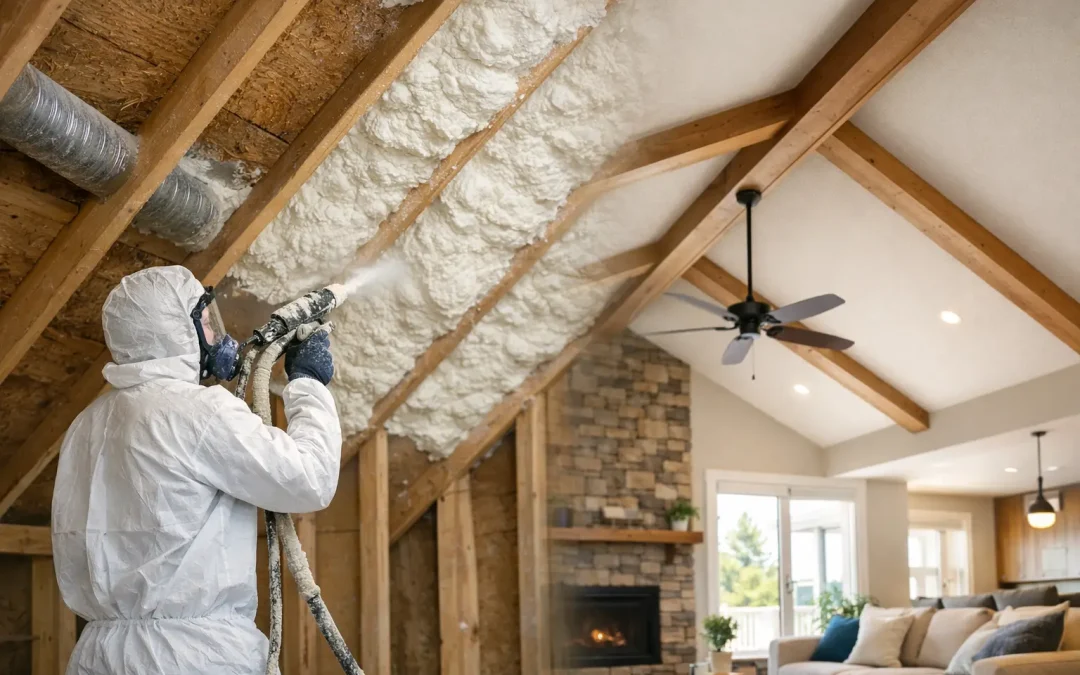
A vaulted ceiling can be one of the best features in a home – and one of the hardest areas to insulate correctly. Spray foam for vaulted ceilings turns that difficult roofline into a high-performance building assembly by insulating and air sealing in the same application. Done properly, it can eliminate the hot ceiling surfaces, winter drafts, and uneven room temperatures that conventional insulation often leaves behind.
For Arizona homes, especially those exposed to intense sun, cold mountain nights, and big temperature swings, the roof assembly does a tremendous amount of work. The right insulation strategy protects comfort, HVAC efficiency, and the long-term condition of the structure. The wrong one can trap moisture, allow air leakage, or leave too little room for effective insulation.
Why Vaulted Ceilings Need a Different Insulation Approach
Unlike a standard attic floor, a vaulted ceiling has little or no attic space between the finished ceiling and the roof deck. The insulation must usually fit within the roof rafter cavities or be installed directly against the underside of the roof sheathing.
That limited space matters. Fiberglass batts can provide reasonable thermal resistance when installed perfectly, but vaulted cavities rarely make perfection easy. Wiring, framing irregularities, recessed lights, and narrow rafter bays create gaps and compression. More importantly, fiberglass does not stop moving air on its own. Warm or cool air can leak around it, carrying energy loss and moisture into the roof assembly.
Spray foam adheres directly to the roof deck and framing. It expands into cracks, seams, and hard-to-reach voids, creating a continuous insulated air barrier. Instead of relying on insulation alone to slow heat flow, the assembly also blocks the uncontrolled air movement that makes rooms feel drafty and raises heating and cooling costs.
How Spray Foam for Vaulted Ceilings Changes the Roof Assembly
Applying spray foam to the underside of the roof deck can bring the roofline inside the conditioned envelope of the home. This is commonly called an unvented roof assembly. Rather than venting outdoor air through soffit and ridge vents above the insulation, the roof cavity is air sealed and insulated at the deck.
This approach offers real advantages when mechanical equipment or ductwork is located in the vaulted space. Ducts no longer operate in extreme attic-like temperatures, which can improve system efficiency and help rooms hold a more consistent temperature. It also keeps wind-driven dust and outdoor air from entering through conventional attic ventilation pathways.
However, an unvented roof is not simply a matter of spraying foam and walking away. The foam type, thickness, roof materials, climate conditions, and existing ventilation details all need to be evaluated together. A qualified insulation contractor should inspect the roof assembly before recommending a solution.
Open-Cell Foam: A Strong Fit for Many Interior Rooflines
Open-cell spray foam is lighter, expands significantly during installation, and fills irregular cavities exceptionally well. It is often a practical choice for vaulted ceilings where the main goal is air sealing, sound control, and improved thermal performance within standard framing depths.
Because open-cell foam is vapor permeable, it allows the roof assembly to dry more readily than closed-cell foam. That can be valuable in certain roof designs. It also uses less material per inch, which may make it a more cost-effective way to air seal a large vaulted area.
The trade-off is R-value per inch. Open-cell foam generally needs more thickness to reach a given R-value, so rafter depth matters. It is also not the right choice for every moisture-sensitive roof assembly. If there is a history of roof leaks, questionable flashing, or a design that requires a stronger vapor-control layer, the recommendation may change.
Closed-Cell Foam: Higher R-Value in Less Space
Closed-cell spray foam provides a higher R-value per inch and adds significant rigidity to the assembly. It also resists moisture more effectively than open-cell foam. Where rafter cavities are shallow, roof geometry is tight, or moisture control is a primary concern, closed-cell foam can be the better-performing option.
For example, a vaulted ceiling with limited framing depth may not have enough room for the thickness of open-cell foam needed to meet the desired thermal target. Closed-cell foam can achieve more R-value in the same cavity while delivering an effective air seal.
Its higher cost is the main consideration. Closed-cell foam is a premium product, and not every vaulted ceiling requires it. The best choice is not automatically the densest foam. It is the foam system that meets the roof assembly’s performance requirements without paying for capacity the project does not need.
What Thickness Does a Vaulted Ceiling Need?
There is no responsible one-size-fits-all thickness for vaulted ceiling insulation. Required R-values vary by project, local code requirements, framing depth, roof design, and whether the home is in a hot desert setting, a cooler high-elevation area, or a mixed climate zone.
A deeper rafter cavity gives an installer more options. In some projects, open-cell foam can fill the cavity and provide excellent air sealing and thermal performance. In others, closed-cell foam may be used to reach higher R-values in limited space. Some assemblies use a hybrid approach, combining foam with another insulation material where the roof design and code allow it.
The key is to avoid treating thickness as the only measure of performance. A thinner layer of properly installed foam can outperform a thicker conventional insulation layer if the conventional material has gaps, air leaks, or compression. At the same time, air sealing does not eliminate the need for sufficient R-value. A quality installation must accomplish both.
Details That Can Make or Break the Installation
The roof deck must be dry and in sound condition before foam is applied. Spray foam is not a repair for an active roof leak. If water is entering around penetrations, valleys, chimneys, or flashing, those issues need to be corrected first.
Recessed lighting, electrical boxes, and combustion appliances also deserve careful attention. Older recessed fixtures may not be rated for direct insulation contact. Chimneys and certain vent pipes require clearances from combustible materials. These are building-safety details, not shortcuts an installer should ignore.
Roofing material and future reroofing plans should be part of the conversation as well. Some homeowners worry that foam against the roof deck makes leak detection harder. That concern is understandable, particularly with closed-cell foam, which adheres tightly to the sheathing. The better answer is prevention: start with a sound roof, use experienced roofing and insulation professionals, and address any future leak quickly.
Comfort Benefits You Notice Every Day
The most immediate improvement is usually temperature consistency. Rooms below vaulted ceilings often run hotter in the afternoon and colder after sunset because the roof assembly is underinsulated or leaking air. Spray foam reduces that heat transfer and closes many of the hidden pathways that cause drafts.
Homeowners may also notice quieter interiors. Open-cell foam is particularly helpful for reducing outside noise, while both foam types can limit the air gaps that let sound travel. Better air sealing can reduce dust infiltration and make indoor conditions easier to control, especially when the HVAC system is properly sized and maintained.
Energy savings are another major benefit, but the result depends on the home as a whole. Windows, duct leakage, equipment efficiency, and thermostat habits still affect utility use. Spray foam is most valuable when viewed as part of a complete building-envelope strategy rather than a stand-alone fix.
When Spray Foam Is the Right Investment
Spray foam makes particular sense for vaulted ceilings with no usable attic, exposed ductwork near the roofline, persistent comfort problems, or complicated framing that makes batt installation unreliable. It is also an excellent fit for homeowners and builders who value long-term energy performance, moisture management, and better indoor comfort over the lowest initial insulation price.
At Ridgetopp Insulation, the recommendation begins with the actual roof assembly, not a generic product pitch. Open-cell and closed-cell foam each have a place, and the correct system depends on what the ceiling, roof, and home need to perform well for years.
A vaulted ceiling should feel open and comfortable, not like a radiant heat source in summer or a cold surface in winter. When the roofline is properly air sealed and insulated, that architectural feature can finally deliver the comfort and efficiency the home was built to provide.